

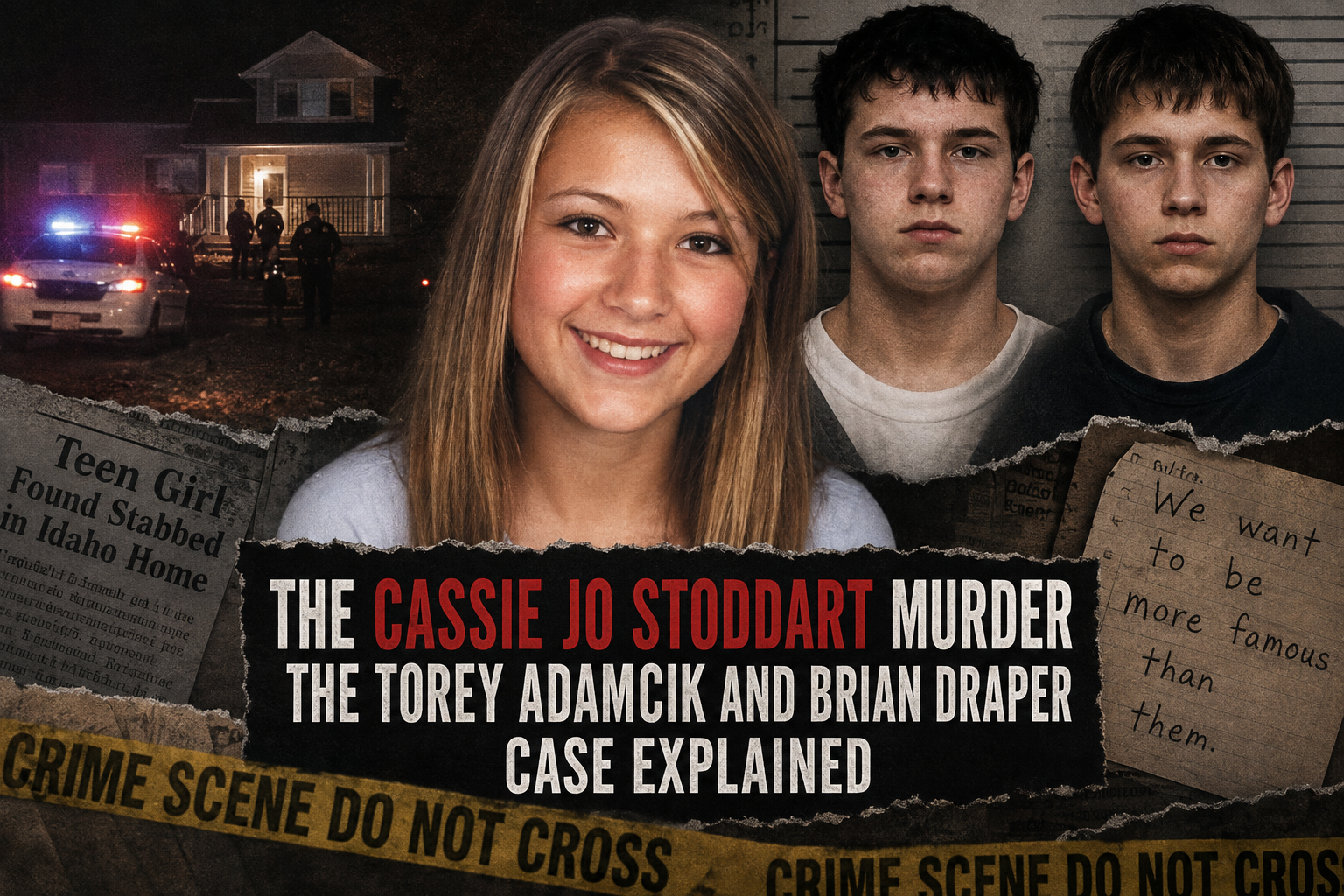
In September 2006, a quiet town in Idaho was shaken by a crime so disturbing that it would later be compared to a horror movie brought to life. The Cassie Jo Stoddart murder, Torey Adamcik, Brian Draper case became one of the most talked-about teen crime stories in the country, not just because of the brutality of the act, but because of the chilling motive behind it. Two teenage boys, both classmates and friends of the victim, planned and carried out a killing they hoped would make them infamous. This article walks through what happened, how the investigation unfolded, and what has happened to those involved in the years since.
Who Was Cassie Jo Stoddart
Cassie Jo Stoddart was a sixteen-year-old girl from Pocatello, Idaho, known by classmates as friendly, well-liked, and full of life. She attended Pocatello High School and had a wide circle of friends. Like many teenagers her age, she spent time with her boyfriend and enjoyed casual weekend plans with people she trusted. Nothing about her daily life suggested she was in any danger, which is part of why her murder felt so senseless and shocking to the community that knew her.
In the fall of 2006, Cassie agreed to house-sit and pet-sit for her aunt and uncle while they were away for the weekend. It was an ordinary favor, the kind of thing teenagers do all the time. That decision, however, placed her alone in a house that two of her classmates had already decided to target.
The Night Everything Changed
On the evening of September 22, 2006, Cassie’s boyfriend, Matt Beckham, came by the house to keep her company. Later that night, two other classmates, Brian Draper and Torey Adamcik, both sixteen years old, stopped by as well. The four of them sat down together and watched a movie. It was a completely normal teenage evening, at least on the surface.
Before the film had even finished, Draper and Adamcik said they were leaving to catch a movie at a local theater. They said their goodbyes and left the house. What Cassie did not know was that the two boys had no intention of going to any theater. Instead, they left, prepared themselves, and returned to the same house a short time later, this time with a plan to terrify and kill her.
They cut the power to the home to plunge it into darkness, put on masks to hide their identities, and waited. When Cassie did not react the way they expected, the two boys entered the living room and attacked her. She was stabbed dozens of times, with injuries across her chest, neck, back, and abdomen. It was later determined that a number of the wounds would have been fatal on their own. Cassie’s body was discovered the next day by relatives, and the scene left investigators and family members devastated.
The Investigation Begins
Police initially focused their attention on Matt Beckham, since he was the last known person to have seen Cassie alive. His subdued reaction to the news of her death raised some early suspicion among investigators. However, Beckham cooperated fully, agreed to a polygraph test, and passed it convincingly. During questioning, he mentioned something that would completely change the direction of the case: two other classmates, Brian Draper and Torey Adamcik, had also stopped by the house earlier that night.
When detectives spoke with Draper and Adamcik, both claimed they had gone to a movie theater after leaving Cassie’s house. That story quickly began to fall apart. A theater employee said the boys had not been there that night, and neither of them could accurately describe the plot of the film they claimed to have watched. These inconsistencies were enough for investigators to keep pressing.
The pressure eventually got to Draper. Before undergoing a scheduled polygraph exam, he broke down and asked to speak with detectives, with his parents present. He admitted that he and Adamcik had returned to the house that night. According to Draper, the original idea was only to scare Cassie by cutting the power and hiding in the dark. He claimed he was shocked when Adamcik began stabbing her, insisting the plan was never meant to go that far. He later led investigators to a location near Black Rock Canyon, where evidence connected to the crime had been buried.
The Disturbing Motive Behind the Crime
What made the Cassie Jo Stoddart murder, Torey Adamcik, Brian Draper case stand out from other teen crime stories was the motive investigators uncovered. This was not a killing driven by anger, jealousy, or an argument gone wrong. Instead, prosecutors described it as a calculated “thrill kill,” carried out because the two boys wanted the experience and the notoriety that came with it.
Investigators discovered that in the days before the murder, Draper and Adamcik had filmed themselves talking about their plans. In these recordings, the two expressed admiration for horror films, particularly the “Scream” franchise, which centers on a masked killer who stalks and murders people who know him personally. The boys appeared to be attempting to recreate elements of that fictional storyline in real life, treating the murder almost like a scene they were staging for their own satisfaction.
Reports from the investigation also suggested that the two teens spoke about wanting to become more infamous than notorious killers from history. Rather than robbery, revenge, or any typical criminal motive, the driving force appeared to be a disturbing desire for attention and a sense of power over another person’s life. This detail is part of what made the case so widely covered and so unsettling to the public, since it painted a picture of premeditated violence rooted in obsession rather than any personal conflict with the victim.
The Trial and Convictions
Given the evidence, including the buried items, the boys’ own recorded statements, and inconsistencies in their stories, prosecutors moved forward with first-degree murder charges against both Draper and Adamcik. The case drew significant media attention throughout the trial, partly because of the ages of those involved and partly because of the calculated nature of the crime.
Both teens were ultimately convicted of first-degree murder. Torey Adamcik has maintained over the years that he did not personally stab Cassie, expressing regret about the outcome while distancing himself from the physical act of the killing. Despite this, the court held both young men responsible for planning and carrying out the attack together. They were each sentenced to life in prison, a sentence that reflected the premeditated and disturbing circumstances surrounding the crime.
In the years following their convictions, both Draper and Adamcik have attempted legal appeals seeking to overturn or reduce their sentences. None of these efforts have succeeded, and both remain incarcerated in Idaho with no scheduled release date. Their case is frequently cited in discussions about juvenile offenders receiving life sentences and how the justice system handles crimes committed by minors who plan and execute deliberate acts of violence.
Why This Case Still Draws Public Attention
Even two decades later, interest in the Cassie Jo Stoddart murder, Torey Adamcik, Brian Draper story has not faded. Part of the lasting fascination comes from how ordinary the setup appeared. Four teenagers, all familiar with one another, spent a casual evening together before two of them left, planned an ambush, and returned to kill one of their friends. The contrast between the mundane beginning of the night and its violent, calculated ending is part of what makes the case so difficult for people to fully process.
The case has been the subject of true crime documentaries, television specials, and podcast episodes over the years, each revisiting the investigation, the trial, and the psychological questions surrounding what drives teenagers to plan this kind of violence. Filmmakers and journalists have used the case to explore themes around media influence, teenage isolation, and how easily disturbing fantasies can escalate when left unchecked. More recent documentary coverage has brought renewed attention to the case, prompting audiences unfamiliar with the original 2006 investigation to learn about it for the first time.
For Cassie’s family and friends, the ongoing public interest carries a different weight. While media coverage and true crime storytelling can raise awareness about warning signs and the justice system’s handling of juvenile offenders, it also means repeatedly revisiting one of the worst moments of their lives. Many families of victims in high-profile cases like this one have spoken about the difficult balance between wanting the story remembered accurately and wanting to move forward with their own healing.
The Lasting Impact of the Case
The Cassie Jo Stoddart murder, Torey Adamcik, Brian Draper case remains a significant example in discussions about premeditated juvenile crime and the influence that media and personal fantasy can have on impressionable teenagers. It also stands as a reminder of how investigators pieced together a case using inconsistencies in testimony, physical evidence, and eventually a confession, even when the suspects were minors with no prior serious criminal history.
Cassie Jo Stoddart was sixteen years old when her life was taken by two people she considered friends. Her case continues to be studied, discussed, and revisited not because of morbid curiosity alone, but because it raises real questions about how well anyone can truly know the people around them, and how quickly a normal evening among friends turned into a calculated act of violence that no one could have predicted.
