

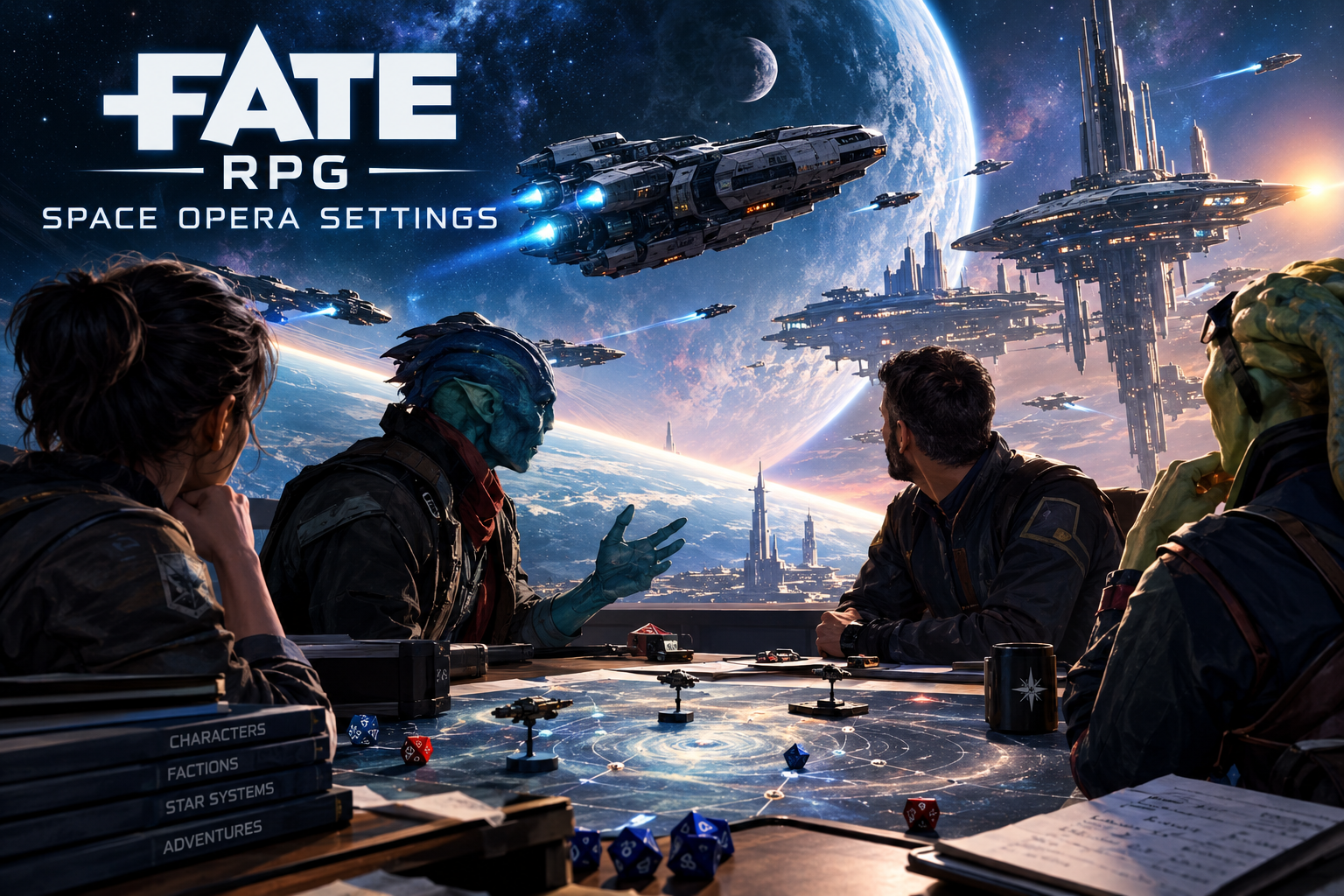
Science fiction storytelling has always thrived on flexible rule systems, and few tabletop frameworks handle sprawling galactic drama as gracefully as Fate. When game masters and players talk about FATErpg space opera settings, they’re really talking about a toolkit built for big stories: starship battles, political intrigue, alien diplomacy, and personal drama that unfolds across star systems. This article walks through what makes these settings work, why the system suits the genre so well, and how tables actually build and run them.
What Makes Fate a Good Fit for Space Opera
Fate is a narrative-first system. Instead of tracking hundreds of stats and modifiers, it relies on Aspects, Fate Points, and a small set of core mechanics that keep the story moving. That lightness matters a lot when you’re trying to run FATErpg space opera settings, because space opera as a genre is sprawling by nature. You’ve got empires, rebellions, ancient alien ruins, sentient AI, and characters who need to feel larger than life without drowning the table in bookkeeping.
Because Fate cares more about narrative truth than simulation, it lets game masters improvise a black hole collapsing, a betrayal on the senate floor, or a daring boarding action without pausing to consult ten different charts. That improvisational strength is exactly what space opera demands, since the genre is built on momentum and consequence rather than granular realism.
The Role of Aspects in Building a Galaxy
Aspects are short descriptive phrases that define a character, location, or situation. In FATErpg space opera settings, aspects do a huge amount of heavy lifting. A starship might have an aspect like “Held Together With Hope and Duct Tape,” which tells the whole table something about its reliability without needing a mechanical damage chart to prove it.
Aspects also extend to factions and planets. A world under martial law might carry the aspect “Boots on Every Corner,” instantly signaling danger and tone. This is one of the reasons Fate scales so well to galaxy-spanning campaigns: the setting itself becomes a character, described in the same expressive language as the players.
Because aspects can be invoked for bonuses or compelled to introduce complications, they give players and game masters a shared vocabulary for steering the story. That shared vocabulary becomes essential once a campaign spans multiple star systems, since keeping track of political factions and ship rivalries through traditional stat blocks would quickly become unwieldy.
Fate Points and Dramatic Momentum
Fate Points are the currency of drama. Players spend them to invoke aspects and gain mechanical advantages, and they earn them back when the game master compels an aspect against them, usually by introducing a complication tied to their character’s flaws or the setting’s tensions.
This loop is especially satisfying in FATErpg space opera settings because the genre rewards characters who take risks for a greater cause. A smuggler captain reluctantly returning to help an old rebel contact, a diplomat forced to choose between duty and friendship — these are exactly the kinds of story beats that Fate Points are designed to reward. The economy nudges players toward embracing complications instead of avoiding them, which keeps the pacing cinematic rather than cautious.
Building Star Systems and Factions
When designing a galaxy for Fate, most game masters start broad and narrow down. Rather than mapping every planet in exhaustive detail, they sketch a handful of key locations, each with a strong aspect and a clear tension. A trade hub controlled by a crumbling corporate dynasty. A frontier world caught between two rival mining guilds. A derelict generation ship rumored to hold pre-collapse technology.
This approach fits naturally with how FATErpg space opera settings are typically structured during actual play. Rather than pre-plotting an entire star map, tables often build the setting collaboratively at session zero, letting players stake claims on factions, homeworlds, and rivalries. That collaborative worldbuilding is one of Fate’s signature strengths, and it works particularly well for space opera because the genre thrives on player investment in bigger political and cultural stakes.
Factions in these campaigns typically get their own aspects, skill approximations, and stress tracks, treating them almost like characters in their own right. A rebellion might have high Resolve but low Resources, meaning its people are motivated but underfunded. That kind of abstraction lets game masters run large-scale conflicts, like a sector-wide war, without needing separate wargame rules bolted onto the main system.
Starship Combat and Vehicle Rules
No exploration of FATErpg space opera settings would be complete without touching on starships, since ship-to-ship combat is often the genre’s signature set piece. Fate handles vehicles the same way it handles characters: aspects, skills, stress, and consequences, just scaled up to represent a ship’s crew and hardware collectively.
Many published Fate space settings, and homebrew hacks built on the Fate Core or Fate Condensed toolkits, treat the ship as an extension of the player characters rather than a separate entity with its own sheet full of numbers. A pilot’s Piloting skill might directly translate into the ship’s maneuvering roll, while the ship’s own aspects, like “Retrofitted War Cruiser” or “Barely Patched Hull,” modify the outcome.
This keeps starship combat fast and cinematic. Instead of tracking shield percentages and weapon ranges down to the meter, the table narrates a daring flyby past an asteroid field, invokes an aspect for extra effect, and moves the story forward. That pacing is a major reason space opera fans gravitate toward Fate over more simulation-heavy science fiction systems.
Existing Fate-Based Space Settings Worth Knowing
Several published settings demonstrate how flexible the system is. Diaspora, one of the earliest Fate-powered science fiction games, focused on procedurally generated star clusters and hard science fiction themes, showing that FATErpg space opera settings don’t have to lean pulpy to work.
On the more adventurous end, Bulldogs! leaned into gritty bounty-hunter space opera, giving players a rougher, more mercenary tone. Fate of Cthulhu and other genre-blend books have also borrowed space opera trappings for cosmic horror crossovers, proving how adaptable the chassis really is.
Many groups skip published settings entirely and build their own homebrew galaxies using Fate Core or Fate Condensed as the base ruleset. This do-it-yourself approach is extremely common in the Fate community, partly because the core books are explicitly designed to be setting-agnostic toolkits rather than locked-in universes.
Designing NPCs and Alien Cultures
Alien species and NPCs benefit from the same lightweight approach that makes the rest of Fate work. Instead of writing exhaustive biology or technology sections, game masters often define a species through two or three aspects that capture its worldview and social structure. A hive-minded species might carry an aspect like “We Are Never Truly Alone,” which shapes both roleplay and mechanical interactions.
This technique keeps FATErpg space opera settings feeling alive without requiring encyclopedic prep work before every session. Because aspects can be compelled mid-scene, an alien culture’s core belief can organically create tension exactly when the story needs it, rather than sitting inert in a sourcebook nobody rereads.
NPC stat blocks in Fate are similarly streamlined. Most non-major characters get only a couple of skills and a single stress track, which lets game masters run large crowd scenes, boarding parties, or senate debates without slowing the table down hunting through paperwork.
Running Long-Term Campaigns
Space opera campaigns tend to run long, often spanning years of table time, and Fate has mechanisms built specifically for that kind of pacing. Milestones, which happen at natural story breaks, let players refresh aspects, swap skills, and evolve their characters as the plot moves forward. This keeps character growth tied to the story instead of an abstract experience point counter.
For FATErpg space opera settings especially, milestones give game masters a natural way to reflect the changing political landscape. A character who starts as a disgraced ex-soldier might, after a major campaign arc, gain a new aspect reflecting their rise to rebel command. The system doesn’t just track numbers; it tracks narrative identity.
Extended campaigns also benefit from Fate’s flexible scene structure. Because combat, social conflict, and exploration all use the same underlying mechanics, game masters can move fluidly between a tense negotiation and a firefight without switching rule sets, which matters a great deal when a single session might span a diplomatic summit, a chase sequence, and a ship boarding all in one night.
Tips for New Game Masters
Anyone starting out with FATErpg space opera settings should resist the urge to over-prepare. The system rewards improvisation far more than exhaustive setting documents, so a handful of strong factions and a couple of compelling aspects per location go a lot further than a hundred pages of lore nobody at the table will read in one sitting.
It also helps to lean into player-generated content during setup. Letting players name their homeworlds, describe their ship’s history, or invent a rival faction gives everyone ownership over the setting from session one. That buy-in tends to produce richer roleplay than a game master handing down a fully finished universe.
Finally, don’t be afraid to compel aspects often. New game masters sometimes hesitate to introduce complications, worried it will feel punishing, but in practice compels are what generate the messy, human moments that make space opera memorable. A compelled aspect that forces a captain to choose between the mission and an old friend is often more memorable than any combat encounter.
Frequently Asked Questions
Is Fate a good system for beginners running science fiction games?
Yes. Its lightweight core mechanics make it approachable for new game masters, and its flexibility means you can start simple and add complexity as your table gets comfortable.
Do I need a published sourcebook to run a space opera campaign in Fate?
No. Many tables build entirely homebrew galaxies using just Fate Core or Fate Condensed, since both are intentionally setting-neutral.
How does Fate handle large-scale space battles?
Ships and fleets are typically treated like characters, using aspects, skills, and stress tracks scaled up, which keeps large engagements fast rather than bogged down in granular simulation.
Can Fate support both gritty and pulpy space opera tones?
Yes. The system’s tone is defined almost entirely by the aspects and compels chosen at the table, so it can support anything from hard science fiction realism to swashbuckling pulp adventure.
