

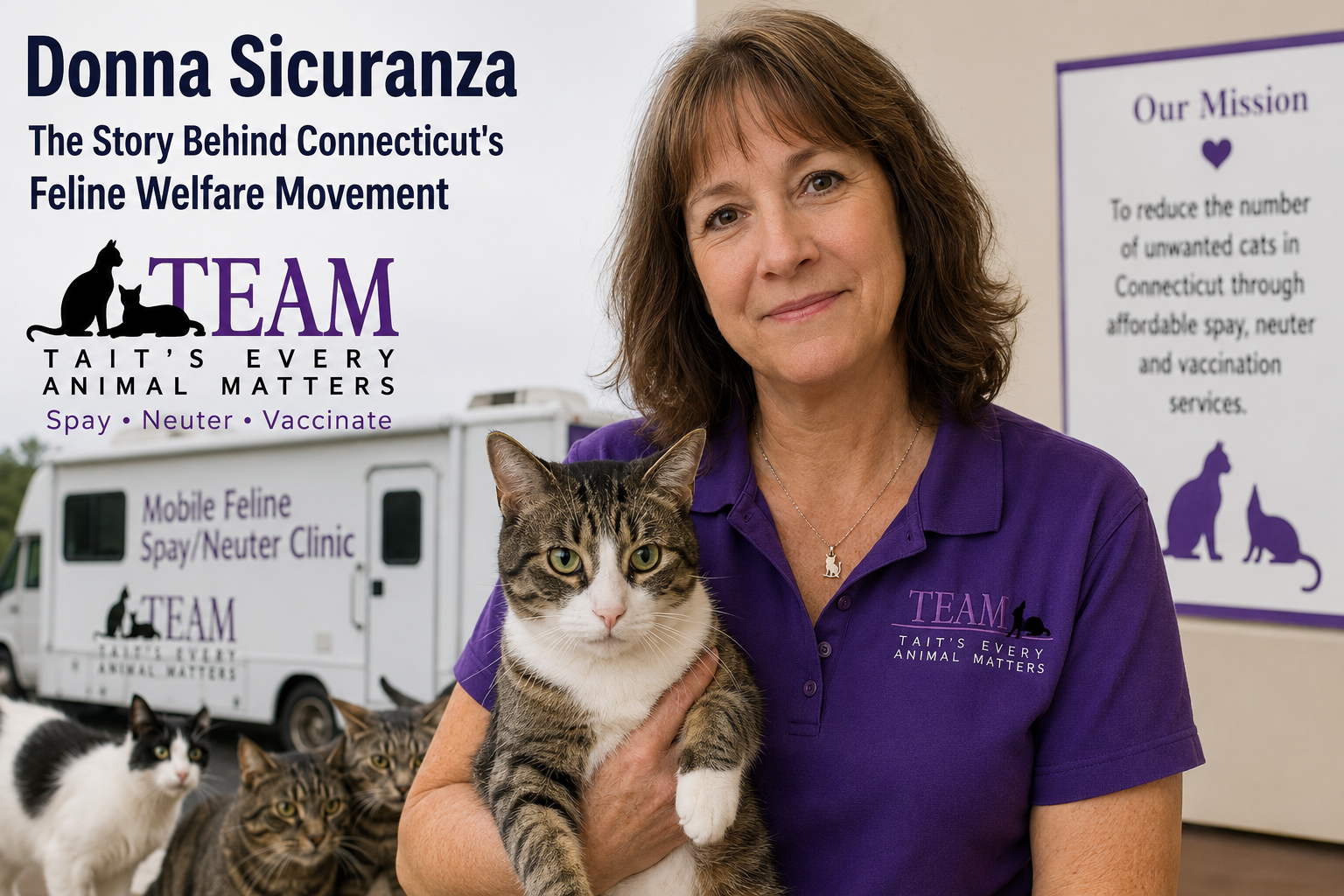
Who Is Donna Sicuranza
Ask anyone connected to animal welfare work in Connecticut, and the name Donna Sicuranza is bound to come up. She is best known as the co-founder and Executive Director of Tait’s Every Animal Matters, an organization more commonly referred to by its acronym, TEAM. Based in Westbrook, Connecticut, TEAM has spent nearly three decades working to reduce the number of unwanted and homeless cats across the state through affordable veterinary care.
For most people who encounter her name online, Donna Sicuranza represents something fairly specific: steady, low-profile leadership in a field that rarely gets much public attention. She hasn’t built a public persona around herself. Instead, her reputation has grown through the results of her work — thousands of cats spayed, neutered, and vaccinated, and a mobile clinic model that other organizations have looked to as an example.
The Founding of Tait’s Every Animal Matters
The organization that would come to define much of her career began in 1997. Alongside veterinarian Dr. John Caltabiano, she helped establish TEAM with a straightforward but ambitious goal: bring down the number of unwanted cats in Connecticut by making spay, neuter, and vaccination services genuinely accessible.
At the time, cost and convenience were two of the biggest barriers keeping pet owners and caregivers of community cats from getting their animals fixed. Traditional veterinary clinics, while valuable, weren’t always affordable or geographically practical for lower-income families or people caring for feral colonies. TEAM’s answer to this problem was a mobile clinic — a way of bringing the service directly to communities instead of asking communities to come to it.
Building the Mobile Spay/Neuter Clinic Model
The TEAM Mobile Feline Spay/Neuter Clinic became the centerpiece of the organization’s work, and it’s the initiative most closely tied to her leadership. Rather than operating out of a single fixed location, the clinic travels to different towns throughout Connecticut, offering low-cost surgical and preventive care for cats.
This approach solved two problems at once. It reduced the transportation burden on pet owners who might not have a reliable way to reach a distant clinic, and it kept overhead costs down, which in turn kept prices low for the people using the service. Over time, this model became one of the more recognized examples of preventive-care outreach in the state’s animal welfare sector.
According to publicly available information from the organization, TEAM has provided services to more than 225,000 cats since it was founded. That kind of scale doesn’t happen through a single program running quietly in the background — it reflects sustained, hands-on leadership over many years, which is where her role becomes especially significant.
Leadership Philosophy and Approach
What sets Donna Sicuranza apart from many nonprofit leaders is her emphasis on prevention rather than crisis response. A lot of animal welfare work understandably focuses on rescue — pulling animals out of dangerous or overcrowded situations after the fact. TEAM’s philosophy, shaped in large part by her direction, takes a different angle: reduce the number of cats being born into difficult circumstances in the first place.
This preventive mindset shows up in how the organization structures its outreach. Rather than waiting for shelters to fill up, TEAM works to get ahead of the problem by making spay and neuter services routine, affordable, and easy to access. It’s a less dramatic approach than large-scale rescue operations, but it tends to produce longer-lasting results.
Before her work in animal welfare, Donna Sicuranza built a career as a freelance writer, editor, and public relations professional. That background is worth noting, because communications experience often plays an underappreciated role in nonprofit leadership. Being able to explain a mission clearly, build community trust, and keep public messaging consistent are skills that don’t always get credited but tend to matter enormously for an organization’s long-term survival.
Impact on Connecticut’s Cat Population
The practical impact of TEAM’s work, guided by her leadership, is measured in numbers that are hard to overlook. Hundreds of thousands of feline sterilization and vaccination procedures translate directly into fewer unwanted litters, fewer cats ending up in overcrowded shelters, and fewer animals living without basic medical care.
Beyond the raw statistics, there’s a broader ripple effect. When a nonprofit demonstrates that a mobile, low-cost clinic model can work at scale, it often becomes a reference point for similar organizations elsewhere. Community cat caregivers, rescue groups, and even municipal animal control programs in Connecticut have engaged with TEAM’s programs, which speaks to the organization’s standing within the state’s broader animal welfare network.
Her name has also appeared in state-level discussions related to animal population control, including working groups organized through Connecticut’s Department of Agriculture. That kind of involvement suggests her influence extends beyond TEAM’s own clinic operations and into how the state thinks about managing cat overpopulation more broadly.
A Note on Name Confusion
Anyone researching Donna Sicuranza online is likely to run into a second, entirely separate set of search results. There was another woman named Donna Marie Sicuranza, a private resident of Pelham, New York, who passed away in March 2017 at the age of 74. She spent more than two decades working at a bank in Bronxville, New York, and was remembered by her family as a devoted wife, mother, and grandmother.
Because both women share a relatively uncommon full name, search engines sometimes blend results from obituary listings, nonprofit directories, and news articles. Based on publicly available information, there is no indication that these two individuals were related or connected in any way. It’s simply a case of an uncommon name appearing twice in unrelated contexts — one tied to a private life in New York, and the other tied to decades of public nonprofit leadership in Connecticut.
For anyone trying to learn more about the Connecticut nonprofit leader specifically, it helps to search alongside terms like TEAM, Westbrook, or feline spay and neuter, which narrows results to the correct person.
Why This Model Continues to Matter
Feline overpopulation is a persistent, often underestimated problem. Cats reproduce quickly, and without intervention, a small number of unaltered animals can multiply into hundreds within just a few years. Shelters across the country regularly report being over capacity, particularly during kitten season in the warmer months.
Prevention-focused programs like the one run out of Westbrook address this at the source rather than after the fact. Instead of relying solely on adoption events or emergency intake, the mobile clinic model reduces the number of kittens being born into situations where resources are already stretched thin. This is part of why the organization’s approach has held up as a long-term strategy rather than a short-term fix.
There’s also a public health angle worth mentioning. Vaccination services offered alongside sterilization procedures help reduce the spread of preventable diseases among both owned and community cat populations. For caregivers managing feral colonies, this combination of services is often difficult to access through traditional veterinary channels, which makes a low-cost mobile option especially valuable.
Recognition and Legacy
Nearly thirty years into her leadership at TEAM, Donna Sicuranza’s legacy is fairly straightforward to summarize: she helped build one of Connecticut’s most consistent and results-driven animal welfare programs, and she did it through a model rooted in prevention rather than reaction.
She hasn’t sought out a high public profile, and detailed information about her personal life outside of her professional work remains limited by choice. That’s consistent with how she has approached her role generally — the focus has stayed on the organization’s mission and its measurable outcomes rather than on personal recognition.
For a field where turnover and burnout are common, nearly three decades of steady leadership is notable on its own. Combined with the scale of TEAM’s work, it’s easy to see why she continues to be referenced in conversations about effective, community-based animal welfare programs in the region.
FAQs
Who is Donna Sicuranza? She is the co-founder and Executive Director of Tait’s Every Animal Matters (TEAM), a Connecticut nonprofit focused on affordable feline spay, neuter, and vaccination services.
When did she start leading TEAM? She has served in this role since the organization’s founding in 1997.
What is TEAM’s main program? Its flagship initiative is a mobile clinic that travels throughout Connecticut, offering low-cost sterilization and vaccination services for cats.
Is she the same person mentioned in a 2017 obituary from New York? No. That refers to a different woman, Donna Marie Sicuranza, a private resident of Pelham, New York, who has no documented connection to TEAM or Connecticut animal welfare work.
What was her career before nonprofit leadership? She worked as a freelance writer, editor, and public relations professional before helping establish TEAM.
Final Thoughts
The story of Donna Sicuranza is, in many ways, a story about consistency. It’s not built around headlines or dramatic rescues, but around the slow, steady work of making veterinary care accessible to people and animals who might otherwise go without it. Over almost three decades, that consistency has added up to a meaningful shift in how Connecticut approaches feline overpopulation — and it’s a legacy that continues to shape the state’s animal welfare landscape today.
