

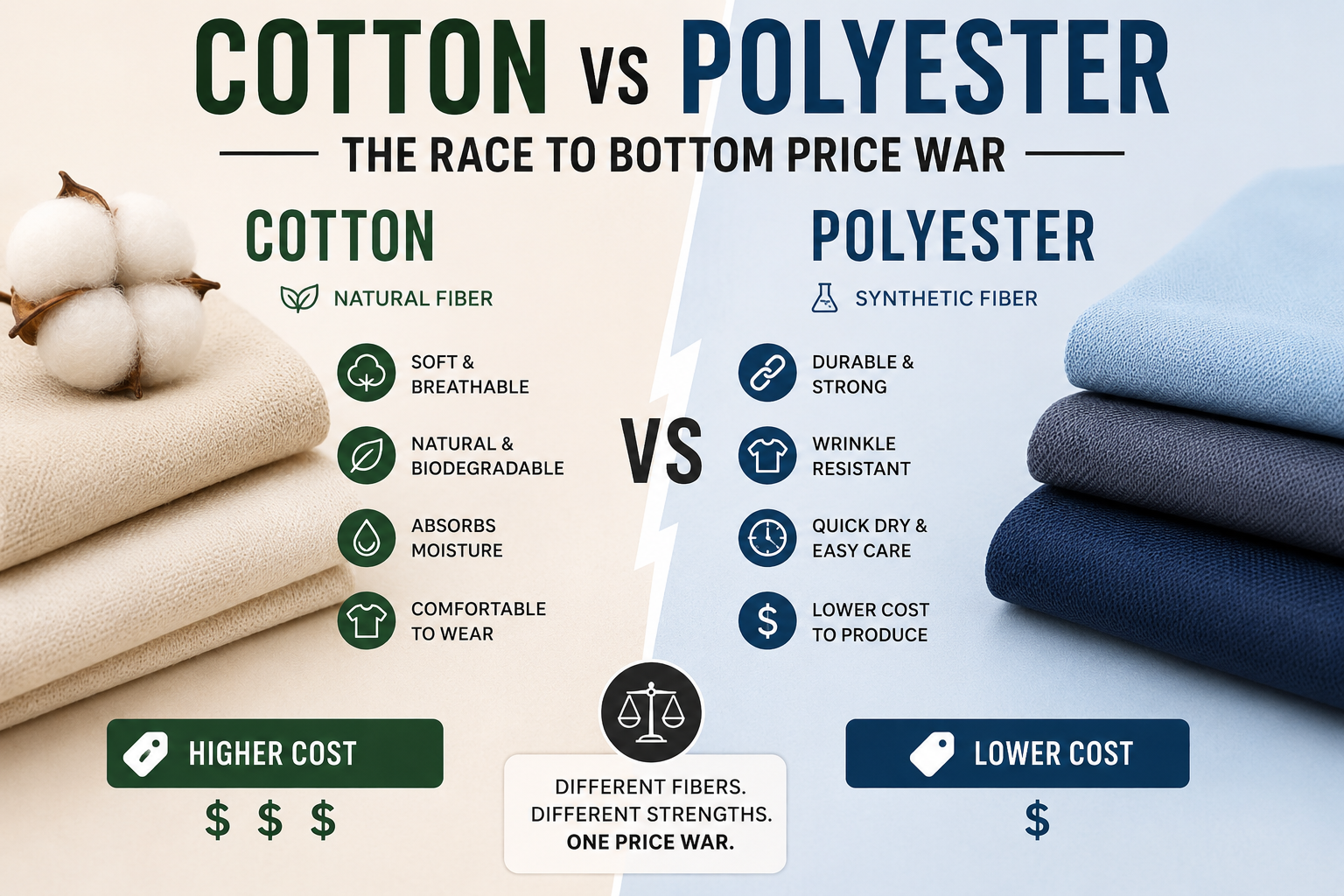
Walk into any clothing store today and pick up two nearly identical t-shirts. One is priced at eight dollars, the other at twenty-five. Chances are the cheaper one is made largely from polyester, and the pricier one leans on cotton. That price gap is not an accident. It is the visible result of a decades-long struggle between two fibers, each fighting to dominate shelf space, factory output, and consumer wallets. This struggle has a name among people who track the textile industry closely: cotton versus polyester, the race to bottom price war.
Why Two Fibers Ended Up Fighting Over Price
Cotton has been humanity’s go-to fabric for thousands of years. It is soft, breathable, biodegradable, and carries a certain emotional weight — people associate it with comfort and authenticity. Polyester, on the other hand, is a much younger invention, built from petroleum byproducts in a lab rather than grown in a field. It is durable, wrinkle-resistant, and can be manufactured at a scale and speed that natural fibers simply cannot match.
For a long time, these two fibers coexisted without much direct competition, since they served different price points and different purposes. But as global manufacturing matured and synthetic production techniques became cheaper, polyester began undercutting cotton on cost at a pace that changed the entire industry. That shift is really the origin story of cotton versus polyester, the race to bottom price war — a conflict driven less by fashion trends and more by raw economics.
The Cost Structure Behind the Conflict
Cotton farming depends on land, water, weather, and labor. A bad harvest season, a drought, or a spike in fertilizer costs can send cotton prices climbing within months. Polyester production, by contrast, is tied to oil prices and factory output, which can be scaled up almost instantly when demand rises. This fundamental difference in supply flexibility gives polyester a built-in advantage whenever manufacturers are under pressure to cut costs.
When oil prices are low, polyester becomes remarkably cheap to produce, and clothing brands shift their sourcing toward synthetic blends almost overnight. This is one of the clearest triggers of cotton versus polyester, the race to bottom price war, because it shows how quickly manufacturers will abandon natural fibers the moment the math favors synthetics.
How Fast Fashion Accelerated the Price War
Fast fashion did not invent the tension between these two fibers, but it poured fuel on it. Brands built entire business models around producing huge volumes of clothing at the lowest possible price, refreshing collections every few weeks instead of every season. Polyester fit that model perfectly. It could be dyed quickly, shipped in bulk, and did not shrink or wrinkle during transport, all of which reduced costs at nearly every stage of production.
Cotton simply could not keep pace with that rhythm without significant price increases somewhere along the supply chain. As a result, many retailers quietly reduced the cotton content in their garments, blending in polyester to stretch their margins further. This blending trend is another chapter in the ongoing story of cotton versus polyester, the race to bottom price war, and it explains why so many modern clothing tags list a mix of both fibers rather than one hundred percent of either.
The Hidden Costs Consumers Rarely See
Cheaper polyester garments often come with costs that do not show up on the price tag. Synthetic fibers shed microplastics every time they are washed, and these particles eventually make their way into rivers, oceans, and even drinking water. Cotton, while far from perfect, biodegrades naturally and does not carry that same long-term environmental burden once discarded.
At the same time, cotton production is not without its own hidden costs. Growing cotton requires enormous amounts of water, and in some regions it has contributed to soil degradation and heavy pesticide use. So while polyester wins on manufacturing price, cotton often loses ground on land and water demands. This tradeoff is central to understanding cotton versus polyester, the race to bottom price war, because neither fiber is cheap once its full lifecycle is taken into account.
Quality Versus Affordability: A Trade-Off Nobody Escapes
Ask any tailor or textile expert, and they will tell you that fiber quality and price rarely move in the same direction. Polyester garments tend to feel less breathable and can trap heat and odor more easily than cotton, especially in warm climates. Cotton, meanwhile, tends to fade, shrink, and wear out faster if it is not treated carefully, particularly in cheaper, lower thread-count varieties.
Manufacturers know this trade-off well, and many now use blended fabrics specifically to balance the strengths of both fibers while keeping costs manageable. A cotton-polyester blend can offer some of cotton’s comfort along with some of polyester’s durability, all at a price point somewhere between the two extremes. This blending strategy is a direct response to cotton versus polyester, the race to bottom price war, since it allows brands to avoid picking a side entirely.
The Role of Global Trade and Tariffs
International trade policy plays a bigger role in this fiber rivalry than most shoppers realize. Cotton-producing countries sometimes impose export restrictions or subsidies that shift global pricing overnight, while polyester production is more concentrated in a handful of countries with strong petrochemical industries. When tariffs shift or trade agreements change, the balance between the two fibers can tilt dramatically within a single fiscal quarter.
This volatility means that clothing brands cannot simply commit to one fiber long-term without risking their profit margins. Instead, they constantly recalibrate their sourcing strategy based on which fiber currently offers the better price. That constant recalibration is exactly why cotton versus polyester, the race to bottom price war, remains an ongoing and unresolved competition rather than something that settled years ago.
Brand Strategy: Marketing Comfort While Chasing Cost
Interestingly, most clothing brands do not openly advertise this price war to consumers. Instead, marketing tends to emphasize comfort, sustainability, or performance, while the actual fiber choice behind the scenes is driven almost entirely by cost calculations. A shirt marketed as “soft and breathable” might still contain forty percent polyester, simply because that blend hit the target price point during production planning.
This disconnect between marketing language and manufacturing reality is one of the less discussed aspects of cotton versus polyester, the race to bottom price war. Consumers are rarely told explicitly that their favorite affordable brand shifted its fiber ratio last season purely because cotton prices spiked. They just notice, vaguely, that the fabric feels a little different than it used to.
Where Sustainability Fits Into the Price Battle
Sustainability has added a new layer to this rivalry in recent years. Recycled polyester, often made from plastic bottles, has emerged as a way to reduce reliance on virgin petroleum while still keeping costs relatively low. Organic cotton, on the other hand, appeals to environmentally conscious buyers but usually comes with a noticeably higher price tag due to more careful farming practices.
Brands now have to weigh sustainability messaging against actual production costs, and this has added complexity to cotton versus polyester, the race to bottom price war. Some companies genuinely invest in greener fiber sourcing, while others use sustainability language mostly as a marketing layer over decisions that are still fundamentally about minimizing cost.
What This Price War Means for the Future of Clothing
Looking ahead, it is unlikely that either fiber will fully win this competition. Cotton retains cultural and comfort advantages that synthetic fibers struggle to replicate, while polyester offers a cost and durability advantage that is hard to ignore in a price-sensitive market. Instead of one fiber replacing the other, the more probable outcome is continued blending, with brands adjusting ratios based on shifting raw material costs year after year.
For everyday shoppers, understanding this dynamic can actually be useful. Checking a garment’s fabric label offers a small window into a much larger economic story — one where cotton versus polyester, the race to bottom price war, quietly shapes what ends up in stores, how long clothes last, and how much they eventually cost at checkout.
A Quiet War With Loud Consequences
What makes this rivalry so interesting is how invisible it usually is to the average consumer. Nobody buys a t-shirt thinking about petrochemical prices or cotton harvest yields, yet those exact forces determine what fabric ends up in their shopping cart. The competition between these two fibers is not dramatic or loud, but its effects ripple through nearly every closet on the planet.
In the end, cotton versus polyester, the race to bottom price war, is less about which fiber is objectively better and more about which one can be produced cheaply enough to satisfy a market that increasingly prizes low prices over long-term durability. As long as that pressure exists, this quiet but persistent battle between natural and synthetic fibers is likely to continue shaping the clothes we wear for years to come.
