

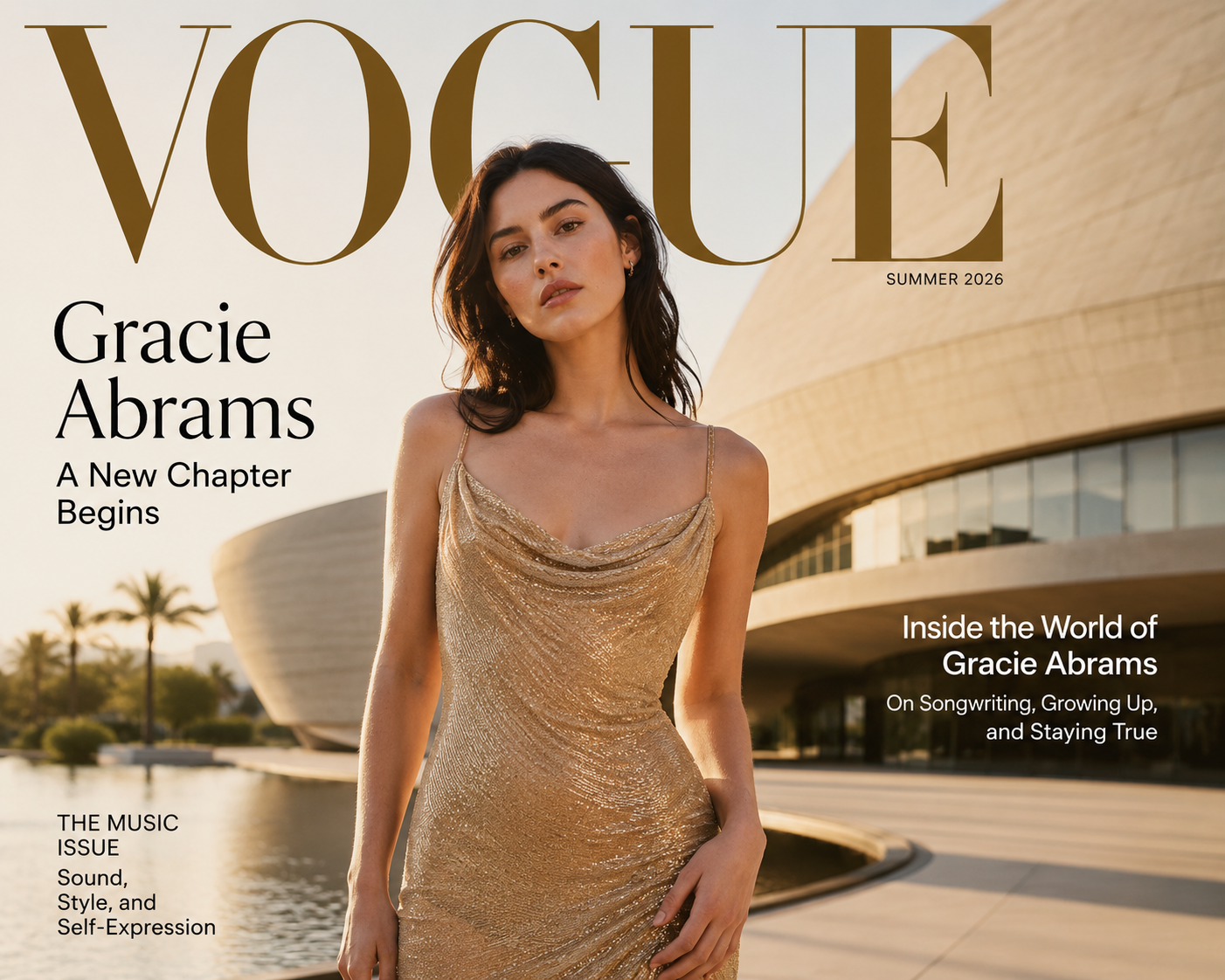
When people search for the Abrams Summer Cover, they are usually looking for one thing: the story behind Gracie Abrams’ appearance on Vogue’s Summer 2026 issue. It is a moment that arrived at the peak of her career, and it has quickly become one of the most talked-about magazine covers of the year. This article walks through what the cover actually shows, why it matters, and why it has sparked such a strong reaction from fans and fashion followers alike.
What This Cover Actually Shows
The Abrams Summer Cover refers to Gracie Abrams‘ feature on the cover of Vogue’s Summer 2026 edition. The singer-songwriter was photographed on location at the Lucas Museum of Narrative Art in Los Angeles, a striking backdrop that has quickly become part of the conversation around the shoot. The image itself is simple by design: Abrams stands in warm, natural sunlight, dressed in a custom champagne-gold floor-length gown from Ralph Lauren Collection.
That simplicity is intentional. Rather than leaning on bold colors or elaborate staging, the cover lets the architecture of the museum and Abrams’ presence do the work. It is a choice that has divided opinion, which is part of why the story has traveled so widely since the issue went live.
Who Is Gracie Abrams
To understand why this cover carries weight, it helps to know a little about the artist behind it. Gracie Abrams has spent the last several years building a reputation as one of pop music’s most personal songwriters. Her lyrics tend to focus on insecurity, relationships, and the quiet, honest moments that most artists gloss over. That openness has earned her a devoted global fan base and growing industry recognition, including Grammy nomination attention.
Her rise has not been quiet. She has toured extensively, collaborated with major names in the industry, and slowly moved from rising newcomer to one of the most recognizable voices of her generation. Landing a Vogue cover is often treated as a marker of that kind of transition, and this feature fits that pattern closely.
The Creative Team Behind the Shoot
Every magazine cover is a collaboration, and this one is no exception. The photography was handled by Larissa Hofmann, who captured Abrams against the museum’s bold, modern architecture. The styling came from Jorden Bickham, who chose the champagne-gold Ralph Lauren gown as the centerpiece of the look.
The choice of location was not incidental either. The Lucas Museum of Narrative Art is a relatively new institution in Los Angeles, and featuring it so prominently gave the shoot a sense of newness that mirrors where Abrams currently sits in her own career. Pairing a rising cultural landmark with a rising artist is the kind of editorial decision that magazines like Vogue tend to make deliberately.
Vogue’s Editorial Direction Under Chloe Malle
Context matters when looking at any major cover, and the Abrams Summer Cover arrives during a notable period for Vogue itself. Editor Chloe Malle has been shaping her own editorial identity since stepping into the role, and her choice of cover stars has reflected a broader mix of culture than in years past.
Recent covers under her direction have featured names spanning music, film, and sports, including a mix of established icons and newer stars. Placing Abrams on the Summer 2026 cover continues that pattern, signaling that Vogue is willing to hand its most visible platform to artists who are still in the middle of their rise rather than only those who have already reached legendary status.
Inside the Cover Story
Beyond the photography, the issue includes an in-depth conversation between Abrams and writer Brittany Spanos. The interview touches on her upcoming album, her songwriting process, and her personal life, including her relationship and the way it has changed how she approaches her music.
Abrams has spoken candidly about how stability in her personal life initially made her worry she would lose the emotional material that fueled her earlier songwriting. That tension between comfort and creative drive is a theme she explores in the accompanying story, giving readers more context beyond the striking visual that anchors the Abrams Summer Cover.
How Fans and Critics Reacted
Reactions to the Abrams Summer Cover have been mixed, and that split is part of what has kept it in conversation. Some readers praised the minimalist approach, arguing that the clean composition allows both the museum’s architecture and Abrams herself to stand out without distraction. Others found the layout too restrained for a summer issue, expecting something brighter or more energetic.
A smaller group of commenters focused less on the visual style and more on the choice of subject itself, questioning why Abrams was selected for such a high-profile cover at this point in her career. Supporters pushed back quickly, pointing to her commercial success and cultural relevance as more than enough justification.
This kind of split reaction is fairly common with modern Vogue covers, especially ones that favor understated elegance over maximalist styling. Still, the volume of discussion around this shoot suggests it struck a nerve, whether people loved it or not.
Why the Minimalist Style Stood Out
Part of what makes this cover interesting is how deliberately it avoids the loud, saturated aesthetic often associated with summer fashion editorials. Instead of beach scenes or vibrant color palettes, the shoot leans into architectural lines, soft natural light, and a single elegant gown.
Several observers compared the tone of the image to Vogue covers from the late 1990s and early 2000s, an era known for cleaner compositions and less visual clutter. That comparison has worked in the cover’s favor for many fans, who see it as a refreshing departure from busier, more heavily produced covers that have become common in recent years.
What This Moment Means for Gracie Abrams’ Career
A Vogue cover is rarely just about fashion. It usually signals how an industry views an artist’s current standing. For Gracie Abrams, the Abrams Summer Cover arrives at a moment when she is transitioning from a promising newcomer into an established name in pop music.
It also gives her a platform to speak on her own terms about where she is heading next, including hints about new music and how her creative process has evolved. Rather than simply promoting a project, the accompanying interview paints a fuller picture of an artist thinking seriously about longevity, not just a single album cycle.
The Broader Cultural Context
Magazine covers like this one do more than sell issues on newsstands. They shape how the public perceives an artist’s cultural weight at a given moment. The Abrams Summer Cover situates Gracie Abrams alongside a growing list of contemporary musicians who have used major fashion covers to mark a turning point in their public image.
It also reflects a shift in how top fashion publications choose their cover stars, favoring relevance and cultural momentum over traditional definitions of fame. That shift benefits artists like Abrams, whose influence comes as much from authenticity and a strong online following as from decades of industry history.
This kind of pairing between a magazine and a mid-career artist also carries commercial weight. Newsstand sales and social media engagement both tend to spike around a well-timed cover, and publications increasingly factor that reach into their editorial planning. An artist with an active, deeply invested fan base can extend a single print issue into weeks of conversation across platforms, something that matters as print media competes for attention in a digital-first landscape. Vogue’s decision to feature Abrams reflects an awareness of that dynamic, treating the cover not just as a fashion statement but as a piece of cultural timing.
Final Thoughts on Gracie Abrams’ Vogue Moment
Whether readers see it as elegant restraint or a missed opportunity for something bolder, the Abrams Summer Cover has done what any successful magazine cover is supposed to do: get people talking. It captures Gracie Abrams at a pivotal point in her career, backed by strong creative choices from the photography, styling, and editorial teams involved.
For fans following her journey, the cover offers both a visual milestone and a deeper look into where she stands personally and professionally. For casual observers, it serves as a reminder that Vogue’s choice of cover star continues to evolve with the culture it covers, one high-profile shoot at a time.
Frequently Asked Questions
What is the Abrams Summer Cover? It refers to Gracie Abrams’ appearance on the cover of Vogue’s Summer 2026 issue, photographed at the Lucas Museum of Narrative Art in Los Angeles.
Who photographed the cover? The shoot was photographed by Larissa Hofmann, with styling by Jorden Bickham.
What is Gracie Abrams wearing on the cover? She wears a custom champagne-gold floor-length gown from Ralph Lauren Collection.
Why has the cover received mixed reactions? Some readers praised its minimalist, architecture-focused composition, while others felt it lacked the energy typically associated with summer fashion covers.
Does the issue include an interview with Gracie Abrams? Yes, the issue features a conversation between Abrams and writer Brittany Spanos, touching on her upcoming album, her songwriting, and her personal life.
Where was the shoot filmed? The shoot took place on location at the Lucas Museum of Narrative Art in Los Angeles, a newer cultural landmark that features prominently throughout the imagery.
