

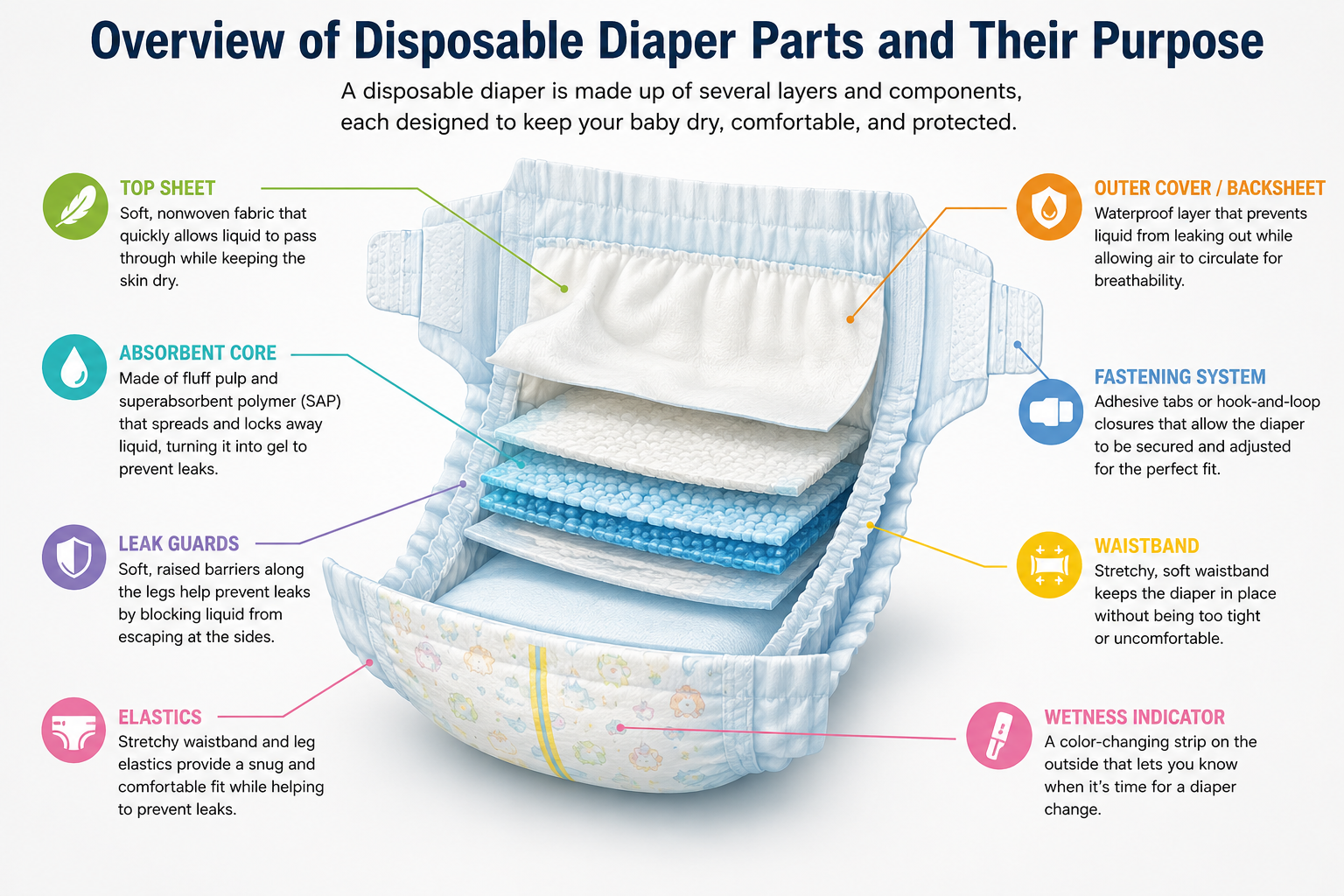
Most parents handle dozens of diapers a week without ever thinking about what actually goes into them. A diaper looks simple from the outside, but it is really a small piece of engineering made up of several layers working together. This overview of disposable diaper parts and their purpose is meant to break down that hidden structure so you can understand why a diaper performs the way it does, and why some brands feel different from others even though they all look similar at first glance.
Once you know what each layer does, shopping for diapers becomes a lot less confusing. You stop guessing based on packaging claims and start recognizing the actual features that make a diaper comfortable, absorbent, or prone to leaking. That is really the goal of this overview of disposable diaper parts and their purpose: to give you a practical understanding rather than just a technical one.
Understanding the Basic Structure
Every disposable diaper is built from three main layers stacked on top of each other. There is a top layer that touches the skin, a middle layer that absorbs liquid, and a bottom layer that keeps everything contained. Around these core layers sit smaller components like elastics, fasteners, and indicators that support the main job of keeping a baby dry.
This layered design has not changed much in decades, even though the materials inside each layer have improved dramatically. Manufacturers have spent years refining thickness, softness, and absorption speed, but the basic three-layer concept remains the foundation of nearly every diaper on the market. Starting with this basic structure gives the rest of this overview of disposable diaper parts and their purpose a clear frame of reference before digging into each individual layer.
The Top Sheet and Its Role
The top sheet is the part of the diaper that sits directly against a baby’s skin. Its main job is to feel soft while still letting liquid pass through quickly into the layers below. If this layer trapped moisture instead of letting it through, babies would sit in wetness, which leads to discomfort and skin irritation.
Most top sheets are made from a nonwoven fabric that is treated to be one-directional, meaning liquid moves inward but does not flow back out toward the skin. This is why a diaper can feel dry to the touch even after it has absorbed urine. The texture of this layer also affects comfort, which is why some diapers feel smoother or more cloth-like than others.
The Absorbent Core
The absorbent core is the heart of the diaper and arguably the most important part to understand in any overview of disposable diaper parts and their purpose. This layer is usually made from a mix of fluff pulp and superabsorbent polymer, often shortened to SAP. The fluff pulp spreads liquid across the diaper, while the polymer locks it into a gel-like form so it cannot leak back out.
Superabsorbent polymer can hold many times its own weight in liquid, which is why modern diapers can be thinner than older versions yet still hold more. The core is often shaped with channels or a slight hourglass design so liquid distributes evenly instead of pooling in one spot. A poorly designed core leads to sagging, bunching, and leaks, even if the rest of the diaper is well made.
The Leak Guards and Elastic Barriers
Leak guards are the small fabric ridges that run along the inner legs of the diaper. They stand up slightly to create a barrier against sudden leaks, especially around the thighs where loose-fitting diapers tend to fail. Without this feature, liquid would simply escape from the sides during movement.
These barriers work alongside the leg elastics but serve a slightly different purpose. While leg elastics create a snug seal against the skin, leak guards act as a second line of defense by physically blocking liquid from spreading outward. Together, they explain why a well-fitted diaper rarely leaks even during active play or overnight sleep.
The Outer Cover or Backsheet
The backsheet is the outermost layer of the diaper, and it is usually the part people notice least even though it does essential work. This layer is waterproof, preventing any liquid that has been absorbed inside from soaking through onto clothing or bedding. At the same time, it needs to allow air to pass through so the skin does not overheat.
This balance between waterproofing and breathability is a defining feature in any overview of disposable diaper parts and their purpose. Older diaper designs used fully plastic backsheets that trapped heat and increased the risk of rashes. Modern versions use microporous materials that let air and vapor escape while still blocking liquid, which is a major reason today’s diapers feel less bulky and cause fewer skin issues than diapers from decades ago.
Fastening Systems
Fasteners are what hold the diaper securely around a baby’s waist, and they typically come in the form of adhesive tabs or hook-and-loop closures. These tabs are reusable to a degree, allowing caregivers to open and reposition the diaper during a fit check without needing to throw it away and start over.
The placement and stretch of these fasteners matter more than people realize. A diaper that fastens too loosely will gap at the waist and legs, causing leaks even if the absorbent core is working perfectly. A diaper fastened too tightly can leave marks or cause discomfort. Good fastener design allows for a range of adjustment so the fit can match a baby’s changing size week to week, which is another detail worth noting in any overview of disposable diaper parts and their purpose.
Waistband and Elastics
The waistband is the stretchy section that wraps around a baby’s belly and lower back. Its job is to keep the diaper in place without digging into the skin, which requires a careful balance of elasticity and softness. Too rigid, and it leaves red marks. Too loose, and the diaper slips down or gaps open.
Leg elastics work in a similar way but focus on the thighs instead of the waist. These stretchy bands create a seal that keeps the diaper snug during crawling, walking, and general movement. Understanding this part is a small but important piece of any overview of disposable diaper parts and their purpose, since a poor elastic design is one of the most common reasons diapers leak even when everything else about the product is high quality.
Wetness Indicators and Additional Features
Many diapers include a wetness indicator, which is a thin strip on the outside that changes color when the diaper has absorbed liquid. This small addition solves a common problem for caregivers, especially with newborns who may not show obvious signs of being wet. Instead of guessing or repeatedly checking, a quick glance tells you whether a change is needed.
Some diapers also include stretchy side panels, aloe or lotion coatings on the top sheet, or added fragrance to mask odor. These extras are not essential to how a diaper functions, but they add convenience or comfort depending on the brand and price point. None of them replace the core layers, but they do explain some of the price differences between basic and premium diaper lines.
Why Understanding These Parts Matters
Knowing the individual components of a diaper helps explain common problems that caregivers run into. If leaks keep happening around the legs, the issue is often the elastics or leak guards rather than the absorbent core. If a baby develops redness after long stretches in one diaper, the backsheet’s breathability might be the deciding factor rather than the brand name on the package.
This kind of practical knowledge is exactly why an overview of disposable diaper parts and their purpose is useful beyond just satisfying curiosity. It gives caregivers a framework for choosing products based on function instead of marketing language. When you understand what each layer is supposed to do, you can identify which part failed when something goes wrong, and you can compare diaper brands based on real differences rather than packaging claims.
It also helps when transitioning between sizes or brands. Babies grow quickly, and a diaper that fit perfectly a month ago may suddenly leak simply because the elastic placement no longer matches the baby’s shape. Recognizing which part of the diaper is responsible for fit versus absorption makes it much easier to troubleshoot these changes without wasting money on trial and error.
Final Thoughts
A disposable diaper may look like a simple product, but it is really a combination of carefully designed parts working together. The top sheet manages comfort, the absorbent core handles the heavy lifting of liquid retention, the backsheet keeps everything contained, and the elastics, leak guards, and fasteners all work to maintain a secure fit. Wetness indicators and other small features add convenience without changing the core function.
This overview of disposable diaper parts and their purpose shows that good diaper performance is not about one single feature but about how well all these components work together. The next time you pick up a pack of diapers, you will likely notice these layers and understand exactly why some feel better, absorb faster, or fit more securely than others. That understanding turns a routine purchase into an informed decision, which is ultimately the most practical benefit of learning how these everyday products are actually built.
