

For centuries, the Navajo people, known to themselves as the Diné, have used color as a language. Long before written records, color told stories about direction, balance, and the natural world. Understanding Navajo clothing colors and symbolism means looking past decoration and into a worldview where every hue carries weight. A woven sash, a dyed skirt, or a beaded collar is never just an outfit. It is a small map of belief, geography, and family history stitched into wool and thread.
This article walks through where these colors came from, what they mean, and how they continue to shape Diné identity today. It is not a simple color chart. It is a living tradition that still shows up at powwows, weddings, ceremonies, and everyday life across the Navajo Nation.
What This Color System Represents
To understand Navajo clothing colors and symbolism, it helps to start with the Diné worldview itself. The Navajo homeland sits between four sacred mountains, one in each cardinal direction. Each mountain has a color, and that color connects to a season, a time of day, and a set of values. This four-part structure shows up again and again in daily life, from ceremonies to weaving to the clothes people choose to wear.
Color, in this context, is directional and spiritual before it is decorative. A weaver choosing yarn is not only thinking about how a garment will look. She may also be thinking about balance, about honoring a direction, or about a story passed down through her family. That layered thinking is what makes Navajo clothing colors and symbolism so different from ordinary fashion choices.
The Four Sacred Colors and What They Represent
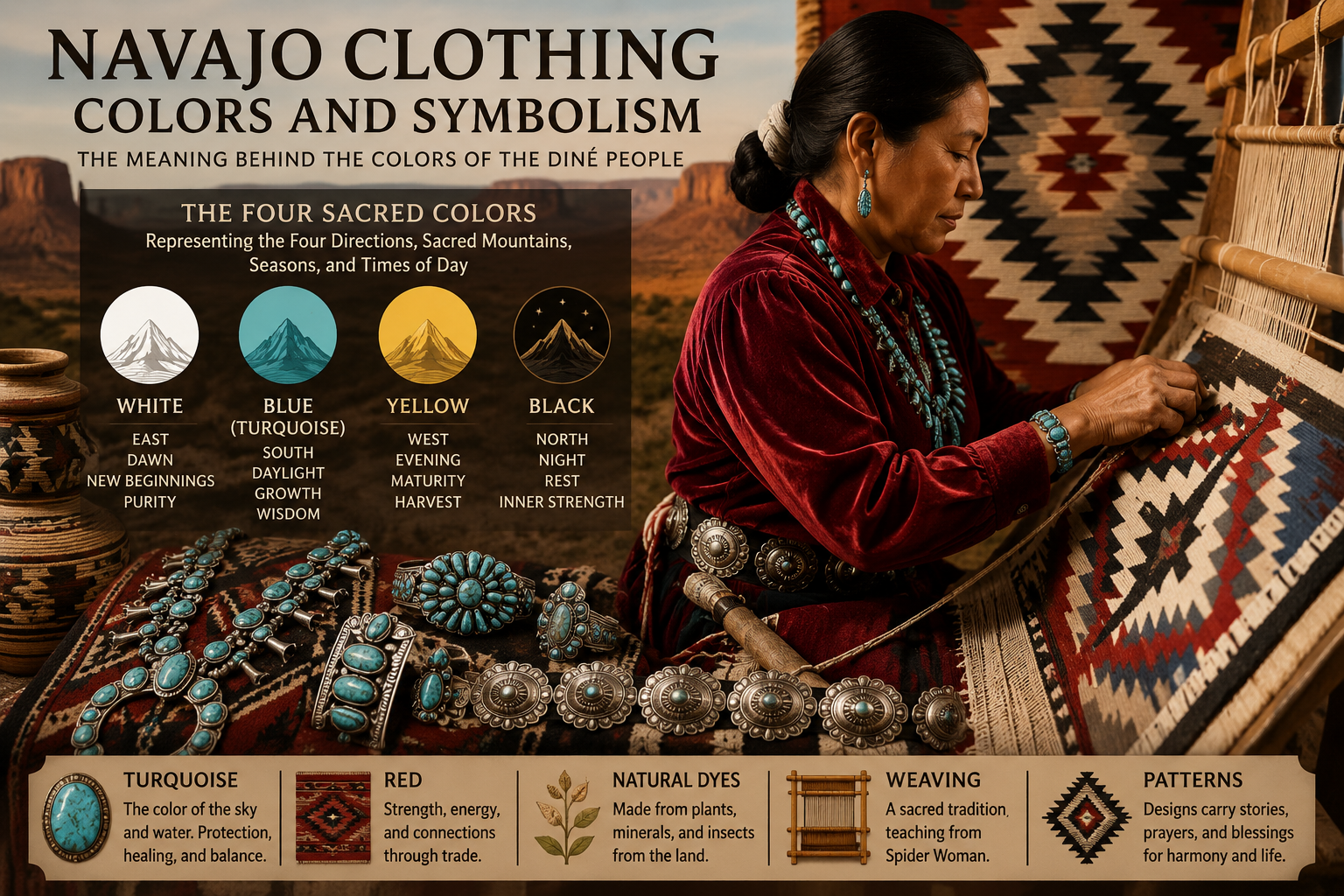
Black, white, blue, and yellow are considered the four sacred colors in Navajo tradition. Each one is tied to a cardinal direction and a sacred mountain that marks the boundary of Diné homeland. White is linked to the east and the dawn, representing new beginnings and the start of a new day. Blue, often described as turquoise, belongs to the south and represents daylight, growth, and wisdom.
Yellow is connected to the west and to the evening light, standing for maturity, harvest, and the fullness of a day’s work. Black belongs to the north and to nighttime, symbolizing rest, introspection, and the quiet strength that comes with darkness. Together, these four colors trace the movement of the sun across the sky, which is why they so often appear in a specific order in weavings and garments rather than scattered at random.
Turquoise: The Color of the Sky and Protection
Turquoise deserves its own mention because of how central it is to Navajo dress. Beyond its role as one of the four sacred colors, turquoise carries associations with protection, healing, and connection to water in an otherwise dry landscape. It appears constantly in jewelry, but it also shows up in woven belts, sashes, and trim work on clothing.
For many Diné families, wearing turquoise is not just about style. It is treated as a way of carrying a bit of sky and water close to the body, a reminder of balance between earth and heaven. This is one of the clearest examples of how Navajo clothing colors and symbolism blend practical beauty with spiritual meaning.
White, Black, and Yellow in Traditional Garments
White in Navajo dress often appears in ceremonial clothing and ceremonial sashes, reflecting purity, dawn, and the beginning of important life events. Brides, for instance, may wear white elements during traditional wedding ceremonies as a nod to new beginnings and clean starts.
Black, while sometimes associated with mourning in other cultures, holds a more complex role here. In Navajo belief, black can represent protection as much as darkness, since night was traditionally seen as a time of rest rather than fear. Black wool, often left undyed from naturally dark sheep, became a practical and symbolic choice for many older weavings.
Yellow shows up in both clothing and accessories, frequently tied to corn pollen, one of the most sacred substances in Navajo ceremony. Corn pollen is used in blessings, and yellow fabric or trim can echo that same sense of abundance and gratitude for the harvest.
Red and Its Place in Navajo Weaving
Red is not one of the four sacred colors, but it holds an important and sometimes complicated place in Navajo textiles. Historically, red dye was difficult to produce locally, so red yarn was often obtained through trade, particularly from Spanish and later American traders. Because of this, red became associated with wealth, status, and outside connection.
Over time, red also took on meanings tied to strength, energy, and even danger, depending on context. In some older weavings, red appears sparingly, used as an accent rather than a dominant color, which made it stand out even more. Its presence in a garment often signaled that the wearer’s family had trade connections or access to valuable materials.
Weaving Techniques and Their Role in These Traditions
Navajo weaving is inseparable from the story of Navajo clothing colors and symbolism, since so much traditional clothing began on the loom rather than with a needle. Diné weavers historically worked upright looms passed down through generations, often taught mother to daughter. The weaving process itself was treated as sacred, tied to the legend of Spider Woman, who is credited in Navajo tradition with teaching the people how to weave.
Patterns were rarely written down. Instead, weavers held designs in memory, adjusting color placement based on the story they wanted the piece to tell. A rug or garment might commemorate a personal experience, a family lineage, or a specific ceremony. The colors chosen were never arbitrary, even when a piece looked purely decorative to an outside eye.
Natural Dyes and the Materials That Created These Colors
Before commercial dyes became available, all Navajo clothing colors and symbolism depended on what could be found in the surrounding desert and mountain landscape. Weavers extracted dyes from plants, minerals, and even insects. Sagebrush, walnut hulls, and various roots produced browns and yellows. Indigo, obtained through trade, created deep blues. Certain clays and minerals were used to darken wool further.
This reliance on nature meant that color was tied directly to the land itself. A yellow dyed from local rabbitbrush was not just a shade; it was a physical piece of the Navajo homeland woven into cloth. That connection between material and meaning is part of why traditional colors still feel significant even now, when synthetic dyes have made nearly any shade possible.
Patterns and Motifs That Carry Meaning
Color rarely stands alone in Navajo design. It works together with pattern, and understanding both is essential to grasping Navajo clothing colors and symbolism in full. Diamond shapes, stepped lines, and zigzag patterns often represent mountains, lightning, or pathways. When these shapes are combined with the four sacred colors, they can represent specific prayers or blessings tied to the four directions.
The whirling log design, an ancient symbol representing motion and the logs set into motion by holy beings in Navajo creation stories, is one well-known example. Because this symbol was later misused by outside groups during the twentieth century, many Navajo weavers stopped using it publicly, showing how deeply tied these patterns are to identity and how carefully their meanings are protected.
Color Choices in Ceremony and Daily Life
Ceremonial clothing follows stricter color guidelines than everyday wear. During healing ceremonies, weddings, and coming-of-age rites like the Kinaaldá, specific colors are chosen deliberately to align with the purpose of the event. White may dominate a dawn ceremony, while turquoise and other blues might be emphasized during rites focused on growth or renewal.
Everyday clothing has always been more flexible. A Diné person might wear a mix of modern fabrics and traditional colors without following strict rules, yet the underlying associations often remain in the back of the mind. Even casual choices, like a turquoise shirt or a black and white patterned skirt, can carry an echo of the deeper system, whether or not it is consciously intended.
Jewelry, Sashes, and Accessories as Extensions of Color Meaning
Clothing rarely stands alone in Navajo dress. Jewelry, belts, and sashes complete the picture and reinforce the same color language found in garments. Silver and turquoise jewelry, in particular, has become one of the most recognizable expressions of Navajo artistry worldwide, but its color symbolism traces back to the same four sacred colors and their meanings.
Woven sashes, often worn at the waist during ceremonies, frequently combine several sacred colors in a single design, representing balance and completeness. Concho belts, another well-known accessory, often use silver to represent light or clarity, paired with turquoise stones for protection. These accessories are not separate from clothing traditions; they are extensions of the same visual vocabulary.
How These Color Traditions Have Evolved Over Time
Contact with Spanish colonizers, later American settlers, and the introduction of the railroad all changed what materials were available to Navajo weavers and tailors. Commercial yarns, aniline dyes, and manufactured fabric widened the color palette dramatically during the nineteenth and twentieth centuries. Bright reds, deep purples, and vivid greens became possible in ways they never had been before.
Despite these changes, the core structure behind Navajo clothing colors and symbolism has remained remarkably stable. Even as new materials entered the picture, weavers and families continued to organize color choices around the same four directions and the same sacred associations passed down through oral tradition. Modern Navajo fashion designers today often blend contemporary silhouettes with these traditional color meanings, creating pieces that feel both current and deeply rooted.
Why This Color Tradition Still Matters Today
In a world full of fast fashion and disposable trends, Navajo clothing colors and symbolism stand out as something intentional and enduring. Every color choice connects back to land, direction, family, and belief in a way that few modern design systems can match. For the Diné, wearing these colors is a quiet but constant act of cultural preservation.
For outsiders learning about this tradition, the lesson goes beyond aesthetics. It is a reminder that clothing can hold memory and meaning far beyond its physical function. When a Navajo weaver selects turquoise, white, black, or yellow for a new piece, she is continuing a conversation that has been going on for generations, one thread and one color at a time.
