

Running a city is one of the toughest jobs in American politics, and the paycheck that comes with it varies more than most people realize. Some small-town leaders quietly out-earn the mayors of major metropolises, while others in cities with millions of residents take home surprisingly modest salaries. Understanding how paid US mayors actually get compensated says a lot about how local government works, and why pay can differ so wildly from one city hall to the next.
There is no national salary chart for mayors. Every city sets its own rules, which means the story of mayoral compensation is really fifty different stories happening at once, shaped by local budgets, council votes, and sometimes just old traditions that nobody has bothered to update in decades.
How Mayoral Salaries Are Decided
Unlike federal or state officials, mayors don’t answer to a single, uniform pay scale. Each city charter or local ordinance spells out how the mayor’s compensation is set, and in most cases, that power sits with the city council.
Some councils tie mayoral pay to a formula, adjusting it each year for inflation or cost of living. Others set a flat number that stays frozen until someone proposes a change, which can then turn into a political fight of its own. A pay raise for a sitting mayor often draws public scrutiny, especially when residents are dealing with rising costs themselves.
This patchwork approach is exactly why comparing mayoral salaries side by side can be tricky. A number that sounds high in one city might reflect decades without an adjustment, while a modest-looking salary elsewhere might have just been bumped up after years of debate.
Why Some Small-Town Mayors Out-Earn Big-City Ones
One of the more surprising patterns in this space is that population size doesn’t reliably predict salary. A village of a few thousand people can pay its mayor more than a city of millions.
Rosemont, Illinois is a good example. With a population of roughly 4,000 residents, its mayor earns a salary that exceeds what Chicago pays its mayor, even though Chicago is home to more than 2.7 million people. The difference often comes down to how the role is structured locally. In smaller municipalities, the mayor sometimes also functions as the city manager, handling day-to-day administrative duties that would normally be split among several departments in a larger city.
That dual-role arrangement shows up again and again on salary lists for city leaders. When one person is effectively doing two demanding jobs, local councils tend to compensate accordingly, regardless of how many people live within city limits.
The Highest Paid US Mayors Right Now
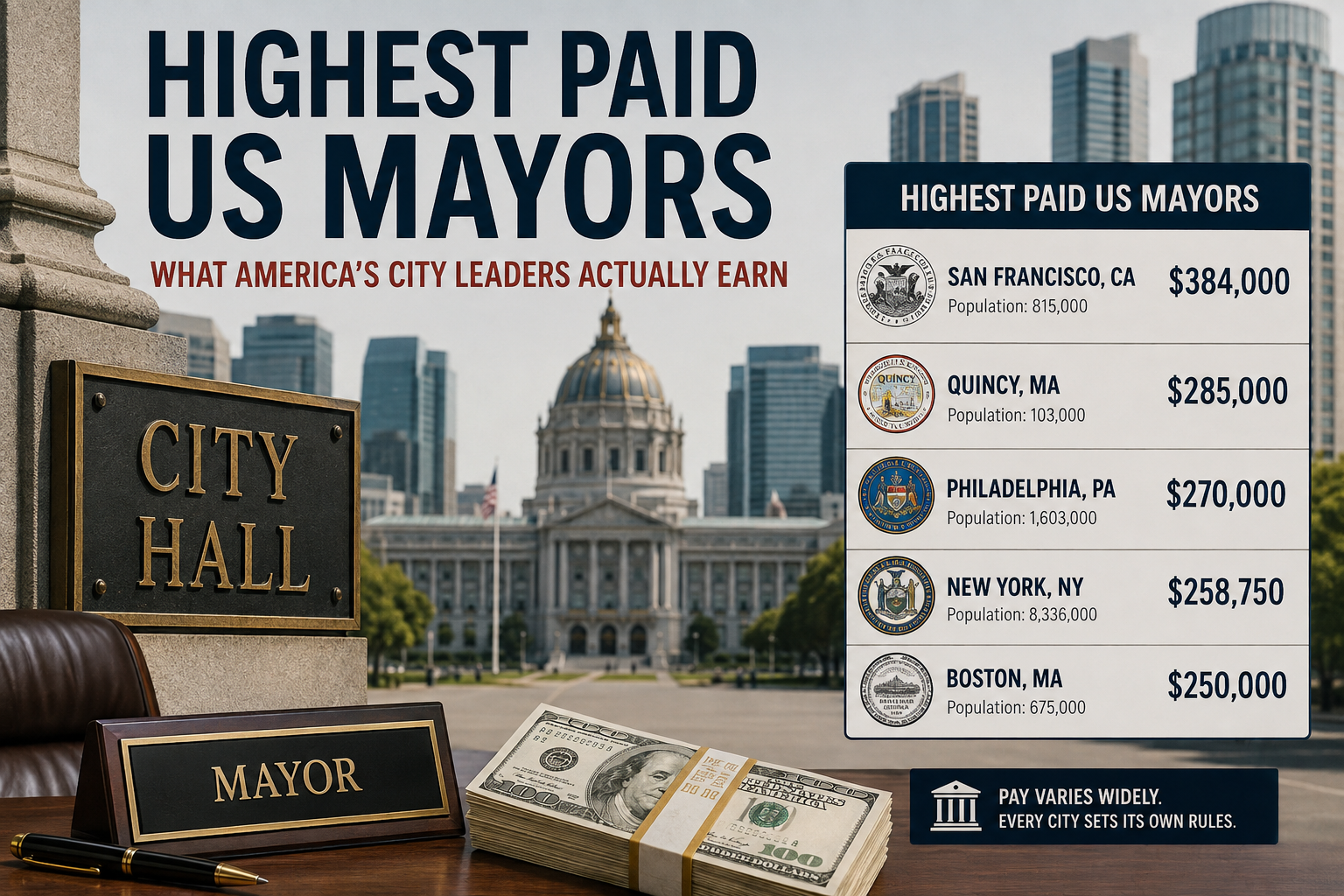
At the top of the list sits San Francisco, where the mayor’s official salary is close to $384,000 a year, making it the highest municipal executive salary in the country. Notably, the current officeholder has chosen to donate the bulk of that pay back to the city, keeping only a symbolic dollar for himself.
Quincy, Massachusetts, a city near Boston with around 103,000 residents, pays its mayor $285,000, which is actually more than Boston’s own mayor earns. That pay level followed a council-approved raise that later drew public pushback, prompting the mayor to defer part of the increase.
Philadelphia’s mayor earns close to $270,000, while Boston’s mayor sits around $250,000. New York City, the largest city in the country by far, pays its mayor roughly $258,750, a number that puts the officeholder well above the six-figure mark, even though a proposed raise to over $300,000 was turned down.
Washington, D.C.’s mayor earns a flat $250,000 under local law, while mayors in Miami Gardens, Chula Vista, Honolulu, Bellingham, Houston, Oakland, Detroit, Dearborn, and Chicago all land somewhere between roughly $210,000 and $260,000. Together, these cities make up a broad cross-section of the highest paid US mayors, spanning both coasts and the Midwest.
Mayors Who Earn More Than Their Governors
A detail that often surprises people is how many paid US mayors take home more money than the governor of their own state. Governors oversee entire states, with budgets and responsibilities that dwarf those of any single city, yet their salaries are frequently lower than what big-city mayors earn.
Florida offers a clear example. When a long-serving mayor in the state retired, his salary was higher than the sitting governor’s pay at the time. This isn’t a one-off quirk either; it shows up in multiple states where legislatures have kept gubernatorial salaries relatively flat while city councils have gradually raised mayoral pay to keep up with the cost of running a modern city government.
The gap highlights an interesting truth about how compensation gets set in American politics. State salaries often move through slow legislative processes, while city councils can act more quickly and are more directly influenced by local economic pressures, union negotiations, and comparisons with neighboring municipalities.
Mayors Who Voluntarily Give Up Their Pay
Not every official on the list of paid US mayors actually keeps the money they’re entitled to. Some mayors, often those who came from successful business or philanthropic backgrounds before entering politics, choose to donate most or all of their salary back to the city.
San Francisco’s mayor is the most prominent example, with a personal net worth reportedly well into the tens of millions, allowing him to accept only a token dollar each year while directing the rest of his official salary toward city programs. Similar gestures have appeared in other cities where independently wealthy officials decided that keeping a six-figure public salary didn’t sit right with them personally.
These voluntary pay cuts don’t change what the position is officially worth on paper, but they do add an interesting wrinkle to any conversation about mayoral pay. The listed salary and the actual amount pocketed by the officeholder aren’t always the same number.
Regional Patterns Among the Highest Paid US Mayors
California stands out when you look closely at where the top salaries in city government tend to cluster. Several California cities appear repeatedly near the top of national rankings, partly because the state’s high cost of living pushes local governments to offer competitive compensation, and partly because many California cities rely on detailed public salary disclosure laws that make this data easy to track and compare.
The Northeast also shows up frequently, with cities in Massachusetts and Pennsylvania offering salaries well above the national average for the role. Meanwhile, the Midwest presents a more mixed picture. Chicago’s mayor earns a solid six-figure salary, but it’s noticeably lower than some of the smaller cities and suburbs surrounding it.
Southern cities tend to vary the most, with some Texas and Florida mayors earning well over $200,000, while others in smaller Southern municipalities take home far less, sometimes only a modest stipend rather than a full salary.
Factors That Push Mayoral Pay Higher
Several practical factors explain why certain cities land higher on lists of paid US mayors than others. City population plays a role, but it’s far from the only one. Cost of living matters enormously, since a salary that feels generous in a lower-cost region might barely cover basic expenses in a place like San Francisco or New York.
The scope of the mayor’s actual authority matters too. In “strong mayor” systems, where the mayor holds significant executive power over budgets, department heads, and city operations, salaries tend to run higher than in “weak mayor” or council-manager systems, where much of the administrative work is handled by an appointed city manager instead.
Union influence, local political culture, and simple precedent also shape the numbers. A city that has historically paid its mayor well is more likely to keep doing so, while a city with a tradition of modest public salaries tends to stay conservative even as costs rise elsewhere.
How Mayor Pay Compares to Other Public Roles
Placing mayoral salaries next to other public sector jobs adds useful context. Many police chiefs, school superintendents, and city managers in large metropolitan areas actually out-earn the mayors they technically work alongside. This is common because those roles are often filled through competitive searches against private-sector benchmarks, while mayoral pay is set through a more political, and sometimes more cautious, local process.
At the same time, some of the paid US mayors on the higher end of the scale now earn more than members of Congress, whose salary has remained fixed for years. That comparison alone shows how uneven the American approach to public sector compensation really is, with pay driven far more by local decisions than by any consistent national standard.
Frequently Asked Questions
Who is currently the highest paid mayor in the United States? San Francisco’s mayor holds the highest official salary among big-city leaders, at roughly $384,000 a year, though he donates the majority of it back to the city.
Do all mayors get paid a salary? No. Many small-town and rural mayors serve on a part-time or volunteer basis, sometimes earning only a small stipend rather than a full annual salary.
Why do some small towns pay their mayors more than big cities? It often comes down to job scope. In smaller municipalities, mayors frequently take on city manager–style duties, handling day-to-day administration in addition to their elected role, which pushes their compensation higher.
Is mayoral pay the same across every state? No. There is no federal or state-standard rate for mayors. Each city or town sets its own salary through local ordinances, city charters, or council votes.
Can a mayor refuse their salary? Yes. Some mayors, particularly those with significant personal wealth, choose to accept only a nominal amount and donate the rest of their official pay to city programs or charities.
Final Thoughts
The story behind paid US mayors is less about a single ranking and more about how differently American cities choose to value the job of running them. Population size, cost of living, local political culture, and the actual powers granted to the office all combine to create a patchwork of salaries that rarely follows a predictable pattern. Some mayors earn more than governors, some earn less than the police chiefs who report to them, and a few choose not to keep their pay at all. That variety, unusual as it is, reflects the deeply local nature of American city government, where every community ultimately decides for itself what leadership is worth.
