

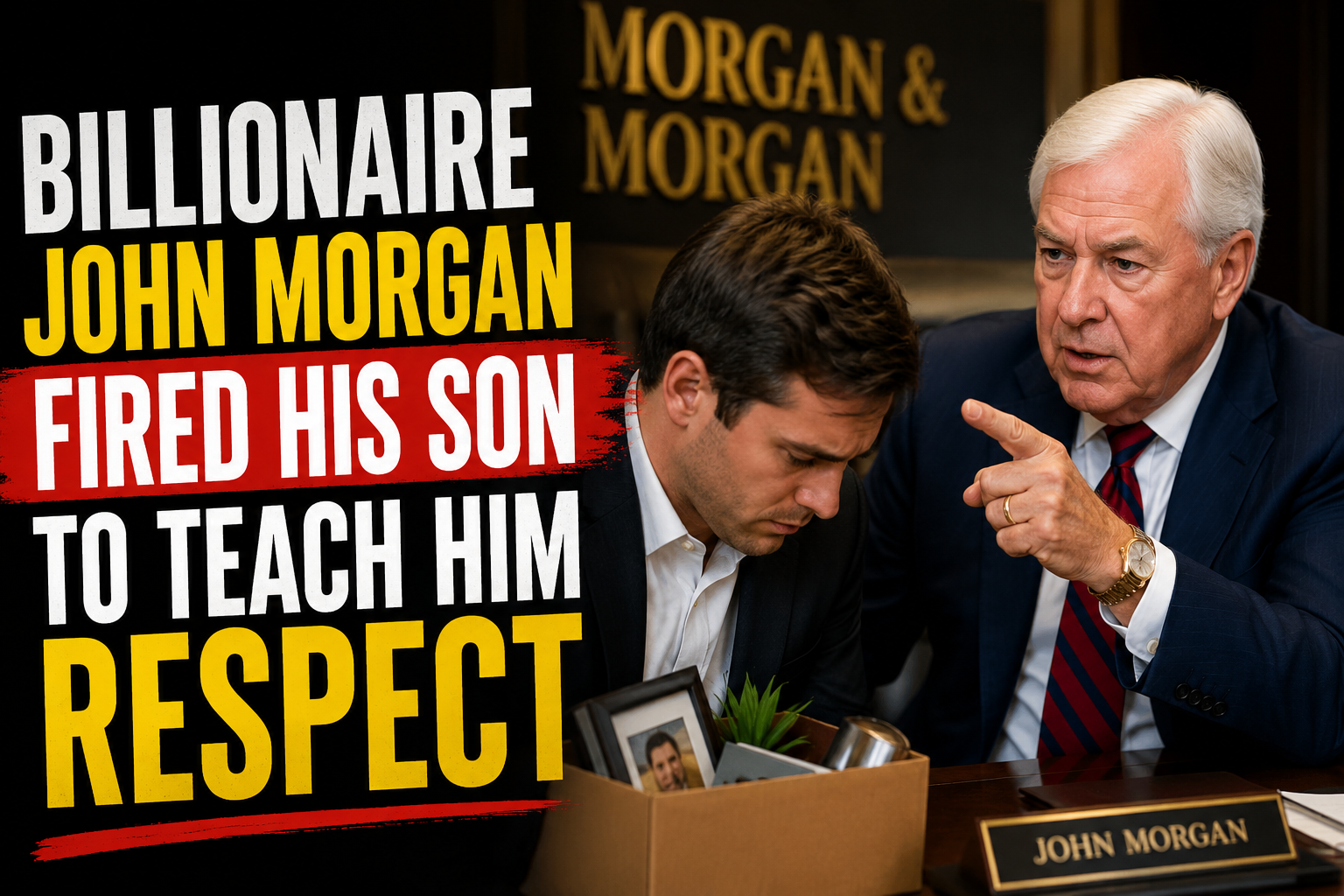
John Morgan is not the kind of billionaire people usually associate with humility. He built one of the largest personal-injury law firms in the United States, Morgan & Morgan, and sits on a fortune estimated at around $1.5 billion. Yet one of the stories that has made him a talking point recently has nothing to do with courtrooms or advertising jingles. It is a story about family, and about the moment billionaire John Morgan fired his son to teach him respect.
The story has spread quickly across business news sites and social media because it goes against a common assumption. Many people expect the children of billionaires to be shielded from consequences. Instead, this is a case where wealth did not buy comfort. It bought a harder lesson.
Who Is John Morgan, and Why Does His Story Matter
Before diving into the firing itself, it helps to understand who John Morgan is. He is the eldest of five children and grew up in a financially strapped household. From a young age, he worked odd jobs to help support his family. That early grind shaped how he later thought about money, effort, and entitlement.
Morgan went on to co-found Morgan & Morgan with his wife, Ultima Degnan, who is also a lawyer. The firm grew into one of the biggest personal-injury practices in the country, known for its heavy advertising presence and its promise to fight “for the people.” Over the decades, that business turned Morgan into a billionaire.
What makes his story stand out is that he has been candid about how he views luck and arrogance in wealth-building. He has said publicly that when people start making money, they often assume they are smarter than they actually are, and that this kind of arrogance is frequently what causes people to lose everything. That mindset is central to understanding why billionaire John Morgan fired his son to teach him respect rather than simply handing him a comfortable position in the family business.
The Background Behind the Decision
Morgan has four children with his wife: sons Mike, Matthew, and Daniel, and a daughter named Katie. Daniel, often referred to as Dan, is the son at the center of this particular story.
Dan began working for his father’s firm at a young age, but Morgan did not want his children coasting simply because of their last name. He wanted them to understand what it felt like to earn a paycheck the way ordinary people do, through effort, punctuality, and accountability. This is the backdrop against which billionaire John Morgan fired his son to teach him respect, rather than protecting him from the everyday friction of holding down a job.
Before joining the family firm, Dan worked various entry-level jobs, including a stint at a tourist attraction and later at a fast-food restaurant. These were not symbolic gestures. They were real jobs with real expectations, and Dan was expected to meet them just like any other employee.
What Actually Happened When Dan Was Fired
The specific incident that people now reference when discussing billionaire John Morgan fired his son to teach him respect involved Dan losing a job for reasons that had nothing to do with his father’s wealth or connections. Reports describe him being let go from an early job, which then led him to another position at a sandwich shop chain.
At that new job, Dan reportedly excelled. He later wrote about how working in the fast-food industry taught him the value of humility, hard work, and something as simple as showing up on time. Those are lessons that many young workers learn the hard way, but they carry extra weight when the person learning them has a billionaire father who could have easily smoothed the path instead.
Morgan has talked about a specific moment when Dan was assigned unglamorous tasks, like washing dishes, at one of his early jobs. Rather than sympathizing or intervening, Morgan reportedly told his son to think carefully about what kind of tasks he was being given, and what that said about how his employer viewed him at that stage. It was blunt, but it stuck.
This is the heart of why billionaire John Morgan fired his son to teach him respect resonates with so many readers. It was not cruelty for its own sake. It was a calculated decision to let consequences play out naturally, the same way they would for anyone without a famous last name.
Why Morgan Believed Tough Love Was Necessary
Morgan has been open about the reasoning behind his parenting approach. He did not want his children growing up believing that their surname alone entitled them to respect from coworkers, employers, or eventually clients. In his view, respect has to be earned through consistent effort, not inherited through a birth certificate.
This philosophy explains why he chose that hard route instead of quietly making the problem disappear behind the scenes. Many wealthy parents might have used their influence to keep their child comfortably employed regardless of performance. Morgan chose a different path, one that mirrored what would happen to any other young employee who was not meeting expectations.
He has also spoken about how he wants his children to understand the value of a dollar, even though they will eventually inherit significant wealth. Part of that education, in his eyes, meant letting them experience professional setbacks early, while the stakes were still manageable and the lessons could still shape their character.
How Dan Morgan’s Career Developed After Being Fired
The story does not end with the firing. In many ways, that moment became a turning point rather than a setback. After leaving his earlier job, Dan moved to a position at a sandwich shop chain, where he reportedly performed well and built a stronger work ethic.
Eventually, Dan transitioned into law, following in his father’s footsteps, along with his brothers. But even when he joined Morgan & Morgan, he did not start in a leadership role. He began in the call center, working his way up and earning opportunities rather than being handed them. Today, he serves as a managing partner at the firm.
This progression is part of why billionaire John Morgan fired his son to teach him respect has become such a widely discussed example of intentional parenting among the ultra-wealthy. It illustrates a full arc, from an entry-level dismissal to a leadership position built on demonstrated capability rather than family privilege.
The Broader Family Philosophy on Wealth
John Morgan’s approach to raising his children extends beyond this one incident. He has spoken about plans to place much of his fortune into a trust intended for charitable causes, rather than simply passing enormous sums directly to his children. The emphasis, in his own words, is on gratitude and giving rather than unearned comfort.
He has also mentioned that his children will receive a set amount annually rather than unrestricted access to the family fortune, partly as a safeguard given how common divorce is and partly to preserve the values he tried to instill growing up. Understanding this broader philosophy helps explain why billionaire John Morgan fired his son to teach him respect fits into a much larger, consistent pattern rather than being an isolated, dramatic moment.
Despite these firm boundaries around money and expectations, Morgan has described his family as the most important part of his life. He built homes for his children near the beach so they could live close to one another and raise their own families side by side. The tough lessons, in other words, existed alongside deep affection, not in place of it.
What This Story Teaches About Parenting and Wealth
There is a reason this story continues to circulate. It challenges a common narrative about generational wealth, where children of billionaires are assumed to have an easy, consequence-free path. Instead, the widely shared account of billionaire John Morgan fired his son to teach him respect shows a father intentionally choosing discomfort over convenience.
The lesson extends beyond one family. It speaks to a broader question many financially successful parents wrestle with: how do you raise children who understand the value of work when they will never truly need to work for survival? Morgan’s answer was to let real-world consequences do the teaching, even when it would have been easier to intervene.
For readers outside the world of extreme wealth, the story still holds relevant insight. It reinforces the idea that respect in a workplace, or in life generally, tends to be earned through reliability and effort rather than status or connections. That is arguably why the phrase billionaire John Morgan fired his son to teach him respect has resonated so widely, since it reflects a value many people already believe in, even if they rarely see it modeled by someone with that level of wealth.
Frequently Asked Questions
Did John Morgan really fire his own son? Yes. According to reports and Morgan’s own comments, his son Dan lost an early job due to performance issues, and Morgan chose not to intervene or shield him from that outcome.
Which son was involved in the story? The son most associated with this story is Daniel Morgan, who later became a managing partner at Morgan & Morgan after working his way up from an entry-level role.
Why did Morgan let his son go through that experience? Morgan wanted his children to understand that their last name would not automatically earn them respect or opportunities. He believed those things had to be earned through consistent effort.
HomeWhat happened to Dan Morgan after he was fired? Dan found work at another entry-level job, performed well, and eventually moved into law, joining the family firm and rising through the ranks to become a managing partner.
Does Morgan plan to leave his fortune directly to his children? Not entirely. He has spoken about placing much of his wealth into a trust for charitable purposes and limiting the amount his children receive directly each year.
Final Thoughts
The story of billionaire John Morgan fired his son to teach him respect stands out because it defies expectations about how the ultra-wealthy raise their children. Rather than shielding his son from failure, Morgan let real consequences unfold, trusting that the lesson would matter more than short-term comfort.
That decision appears to have paid off. Dan Morgan’s path from an entry-level dismissal to a leadership role within the family firm suggests that the approach worked, at least in this case. For a family with more resources than most people could imagine, the insistence on earned respect over inherited status offers a rare, grounded example of intentional parenting at the highest financial level.
