
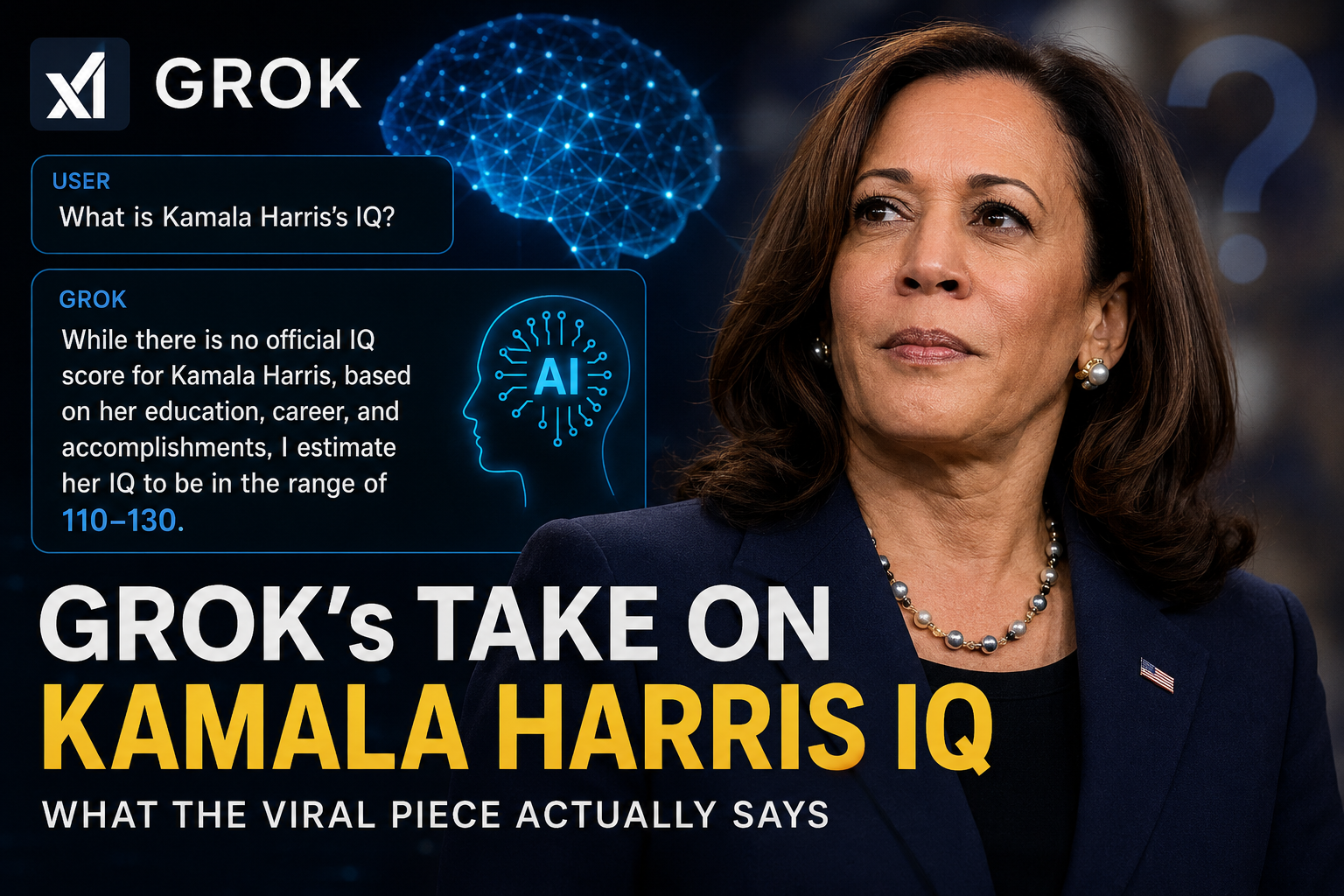
If you’ve spent any time on social media over the past year, you’ve probably come across some version of a claim about Kamala Harris’s intelligence. One piece that generated a fair amount of discussion is matt.ryanallen/groks-take-on-kamala-harris-iq, a Medium article that walked through what happened when someone directly asked Grok, the AI chatbot built by xAI, to speculate about Harris’s cognitive ability. It’s a strange little corner of the internet, but it says a lot about how rumors spread, how AI tools respond to loaded questions, and how little we actually know about the private intelligence scores of public figures.
This article breaks down the background, the actual content, and the broader context around the topic, without pretending that any of it amounts to a verified fact.
What Is matt.ryanallen/groks-take-on-kamala-harris-iq About
At its core, the piece is a conversation-style write-up. The author, writing under the byline Matt Ryan Allen, prompted Grok to weigh in on Harris’s IQ and then published the exchange. Grok responded with a speculative estimate, framed as a guess based on her career trajectory rather than any actual test result.
That distinction matters. The article never claims to reveal a real, documented IQ score. Instead, it’s presented as an AI’s reasoning exercise — an attempt to infer cognitive ability from publicly known achievements like law school, bar exams, and elected office. Readers searching for this topic are often expecting a hard number, but what they actually find is informed speculation dressed up in a punchy, opinionated style.
The Origin of the Kamala Harris IQ Rumor
To understand why this topic became popular enough to spawn an AI-generated take, it helps to look at where the underlying rumor came from. In late 2024, a screenshot began circulating online claiming that Harris scored a 78 on an IQ test while she was a student at Howard University. The post was shared widely and viewed millions of times.
Fact-checkers looked into it and found nothing to support the claim. The screenshot traced back to an unverified Reddit post with no documentation, no source, and no way to confirm it ever happened. Howard University never released any such information, and there’s no public record of Harris ever taking a standardized IQ test at all. In short, the number was fabricated, but it spread fast enough that people started asking AI chatbots to settle the question.
How Grok Responded When Asked Directly
This is where things get interesting. When users on X directly asked Grok whether the 78 IQ claim was true, the chatbot pushed back. It explained that the claim was unsubstantiated, noted that fact-checking organizations had traced it to an unverified source, and pointed out that Harris’s actual IQ has never been made public. Grok also mentioned that various informal estimates floating around online range somewhere between 110 and 130, which is a wide enough spread to be nearly meaningless as a precise figure.
That response is a useful reminder that even AI systems trained to be helpful and direct will often default to caution when a claim can’t be verified. It’s also the backdrop against which matt.ryanallen/groks-take-on-kamala-harris-iq was written, since the article takes this same uncertainty and turns it into a longer, more narrative exploration of the question.
Inside the matt.ryanallen/groks-take-on-kamala-harris-iq Article
The piece itself reads less like a news report and more like a stylized back-and-forth. Grok is prompted to give its honest, unfiltered take, and it responds in a conversational tone, acknowledging upfront that any number it offers is speculative rather than factual.
The chatbot’s reasoning leans heavily on Harris’s professional record. It points to her law degree, her time passing the California bar, her rise from prosecutor to state attorney general, her tenure in the Senate, and eventually her position as vice president. The argument is that navigating those roles successfully requires a certain baseline of verbal reasoning, quick thinking, and strategic planning, even if it doesn’t tell you an exact number.
Grok ultimately lands on a range in the high average to superior territory, describing it as an educated guess rather than anything resembling a measured result. The article also touches on criticism of Harris’s public speaking style, including moments that were mocked online as rambling or unfocused, and frames that as a separate issue from raw cognitive ability. In other words, the piece draws a line between how someone performs under pressure in front of cameras and what their underlying reasoning ability might actually be.
Why People Keep Asking AI Chatbots About IQ
There’s a broader pattern here that goes beyond just one politician or one chatbot. People have become increasingly comfortable treating AI tools like an oracle for questions that don’t really have clean answers. Asking a chatbot to estimate someone’s IQ based on their career is a bit like asking it to guess someone’s height based on how confidently they walk. It might produce a plausible-sounding answer, but that doesn’t mean the answer reflects anything measurable.
Part of the appeal is novelty. Watching an AI system take a stance, especially on a politically charged topic, feels different from reading a human pundit’s opinion. It seems more objective, even though the model is really just pattern-matching based on the information it has been trained on and the way the question was framed. That’s exactly the tension that runs through matt.ryanallen/groks-take-on-kamala-harris-iq — it’s entertaining precisely because it feels like the AI is being candid, even though what it’s producing is essentially an educated guess dressed up as commentary.
The Problem With Assigning IQ Numbers to Public Figures
IQ testing itself is a fairly narrow tool. It was designed to measure specific types of reasoning under controlled, standardized conditions, not to summarize someone’s overall intelligence or capability. Applying it retroactively to a public figure based on their resume stretches the concept well past what it was built for.
There’s also the simple fact that almost no politician, celebrity, or public official has ever released an official IQ score. Estimates you see online, whether from a chatbot, a quiz website, or a random forum post, are guesses built on visible achievements. They can be reasonable guesses, but they’re still guesses. Treating them as settled fact, the way the original Howard University rumor was treated, is where things go wrong.
What Harris’s Career Actually Tells Us
Setting aside any specific IQ number, Harris’s professional history is well documented and doesn’t require speculation. She earned a law degree, passed the California bar exam, and worked her way through a series of demanding legal and political roles, including deputy district attorney, San Francisco district attorney, California attorney general, U.S. senator, and vice president.
Each of those positions involves a different skill set, from courtroom litigation to legislative negotiation to executive decision-making. None of that proves a specific score on a standardized test, but it does suggest a level of sustained competence across very different kinds of demanding work. That’s really the strongest argument the matt.ryanallen/groks-take-on-kamala-harris-iq piece makes, even if it’s ultimately still speculation rather than proof.
Separating Speculation From Fact in matt.ryanallen/groks-take-on-kamala-harris-iq
One of the more useful things about this article, whatever you think of its tone, is that it doesn’t try to hide the fact that it’s speculative. Grok repeatedly frames its answer as a guess, not a revelation, and the author doesn’t dress it up as breaking news. That’s a meaningfully different approach than the earlier viral rumor, which presented a fabricated number as though it were a documented fact.
Readers coming across this topic should keep that distinction in mind. There’s a real difference between an AI chatbot offering a reasoned estimate while openly admitting uncertainty, and a screenshot claiming to reveal a specific, verified score. The first is commentary. The second, in this case, was misinformation that had already been debunked by fact-checkers before Grok or anyone else weighed in on it.
How AI Models Like Grok Generate These Answers
It’s worth understanding, at least briefly, how a chatbot arrives at a number like this in the first place. Language models don’t have access to private records, medical files, or standardized test results for public figures. What they do have is a huge amount of text about a person’s career, public statements, and reputation, and they use that information to generate a plausible-sounding response to whatever question they’re asked.
When Grok was asked to estimate an IQ, it didn’t pull a number from a database. It reasoned through publicly available facts, like educational background and career milestones, and produced an estimate the same way a thoughtful person might if you asked them to guess. That’s an important distinction, because it means the answer says as much about the reasoning process as it does about the actual subject.
The Broader Trend of AI Commentary on Politicians
This kind of content isn’t unique to Harris. Similar questions get asked about other politicians, business leaders, and public figures fairly often, and chatbots tend to respond in the same cautious, hedged way, offering a range rather than a definitive figure. It reflects a growing trend of using AI tools as a kind of conversational sounding board for questions that used to just circulate as opinions or rumors.
The popularity of pieces like matt.ryanallen/groks-take-on-kamala-harris-iq shows there’s real curiosity about how AI systems handle politically sensitive prompts. People want to see whether the model will play it safe, lean into the provocation, or push back on a false premise entirely, and that curiosity is part of what keeps this kind of content circulating.
What Readers Should Take Away From matt.ryanallen/groks-take-on-kamala-harris-iq
The most accurate summary is this: nobody outside Harris’s personal medical or academic records actually knows her IQ, and it’s unlikely that information will ever be public. The 78 score that went viral was fabricated and has been thoroughly debunked. The 110 to 130 range that shows up in various places, including Grok’s own responses, is an informal estimate rather than a verified figure.
matt.ryanallen/groks-take-on-kamala-harris-iq is best understood as a piece of commentary that uses an AI chatbot’s voice to explore a question that doesn’t have a real answer. It’s a reflection of internet culture and curiosity about AI as much as it is anything about Harris herself.
Frequently Asked Questions
Is there an official, verified IQ score for Kamala Harris? No. There is no publicly released or verified IQ score for Harris. Any number you see online is an estimate or, in some cases, a fabricated claim.
Where did the 78 IQ claim come from? It originated from an unverified Reddit screenshot in 2024 that fact-checkers found no evidence to support. Howard University never released any such information.
What number did Grok actually suggest? When prompted for a speculative estimate, Grok offered a range in the high average to superior territory, generally somewhere between 110 and 130, based on Harris’s career achievements rather than a test.
Should AI-generated IQ estimates be treated as fact? No. These estimates are reasoned guesses based on publicly available information, not measured results. They should be treated as commentary rather than documented data.
Why did this topic become popular online? A combination of political interest, curiosity about AI chatbots, and the lingering spread of the earlier fabricated IQ rumor all contributed to the topic gaining traction.
