

Anyone who has ever picked up a bandana has probably wondered about that swirling, teardrop-shaped design printed across it. It shows up on cowboy neckerchiefs, biker headwear, dog accessories, and even high-fashion runway pieces. If you have ever stopped to ask yourself what is the bandana pattern called, you are not alone. This is one of the most recognizable prints in textile history, yet most people who wear it every day have no idea what it is officially named or where it came from.
This article breaks down the answer in detail, along with the history, cultural background, and design reasoning behind the pattern. By the end, you will not only know what is the bandana pattern called, but you will also understand why it has remained popular for centuries.
The Short Answer
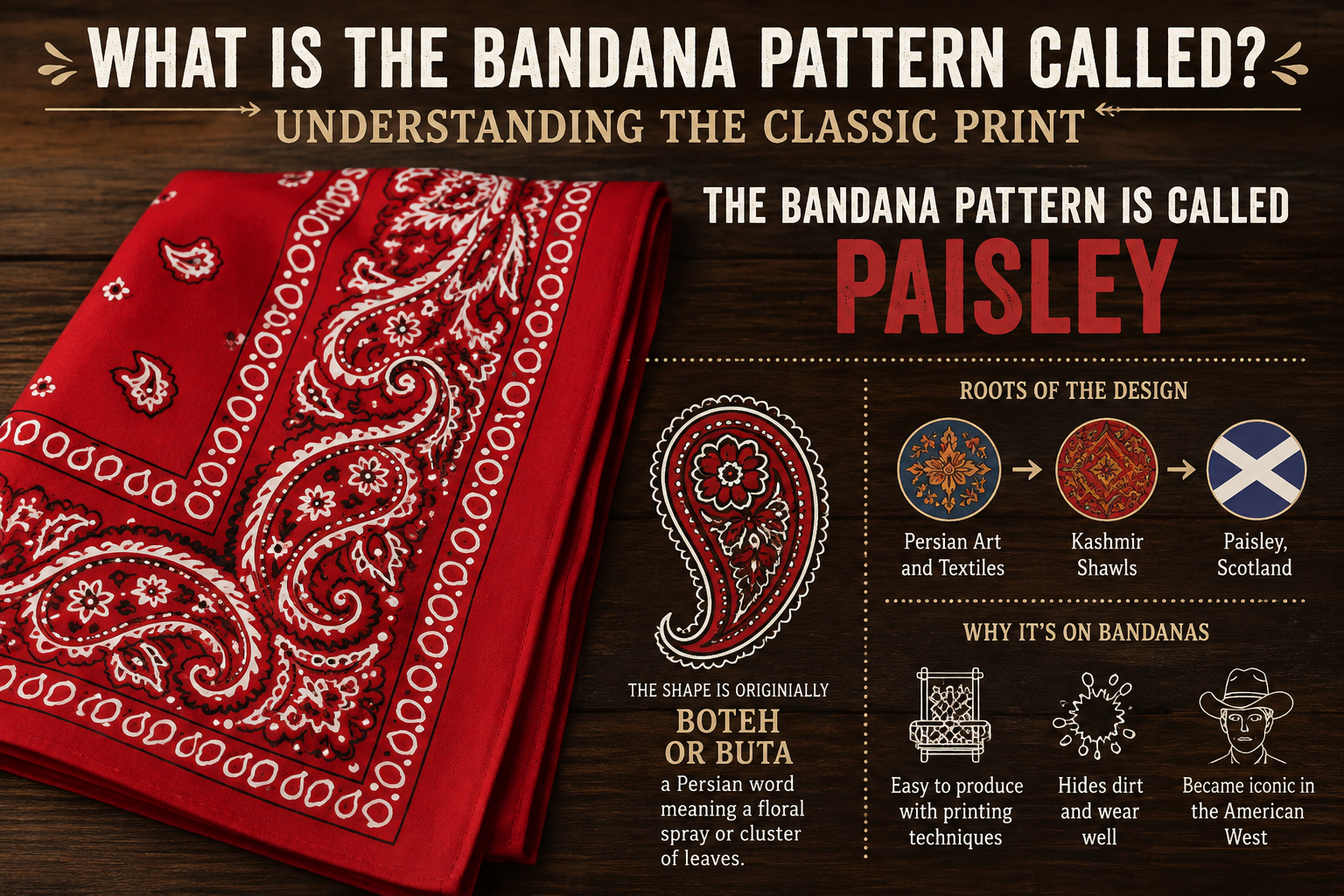
The classic bandana pattern is called paisley. Technically, the swirling teardrop shapes themselves are known as “boteh” or “buta,” a Persian word referring to a cluster of leaves or a floral spray. When this motif is arranged in a repeating, symmetrical layout across fabric, especially on a bandana, the overall design is commonly referred to as paisley print.
So if someone asks what is the bandana pattern called, the simplest reply is paisley. It is a name borrowed from a town in Scotland, even though the design itself originated thousands of miles away in Persia and India. That geographical mismatch is actually one of the most interesting parts of the pattern’s story.
Where The Word Paisley Comes From
To fully understand what is the bandana pattern called, it helps to look at the town of Paisley in Renfrewshire, Scotland. During the eighteenth and nineteenth centuries, Paisley became a major center for textile weaving, particularly shawls that mimicked the intricate patterns being imported from Kashmir in India.
Local weavers in Paisley began producing their own versions of these teardrop designs using jacquard looms, which allowed for faster and cheaper production than the hand-woven originals. Because so much of this fabric came out of the town, the design eventually took on the town’s name in Western markets, even though the pattern had existed in South Asia and the Middle East for centuries before Scotland ever wove a single thread of it.
This naming shift is a good example of how patterns can be renamed based on where they became commercially popular rather than where they were invented. It also explains why so many people searching what is the bandana pattern called are surprised to learn the answer traces back to Scotland at all.
The Persian And Indian Roots Of The Design
Long before it reached Scotland, the boteh motif had deep roots in Persian art and textiles. Some historians trace early versions of the shape back over a thousand years, linking it to depictions of a floral spray, a cypress tree bent by wind, or even a stylized almond or pinecone shape. These interpretations vary, but most agree the motif carried strong symbolic meaning related to life, fertility, and eternity in Persian culture.
From Persia, the design spread into the Kashmir region of India, where it was incorporated into elaborate hand-woven shawls. These shawls became prized luxury items and were eventually exported to Europe, where the intricate patterns caught the attention of wealthy buyers and textile manufacturers alike.
Understanding this origin is essential to answering what is the bandana pattern called with real depth. The pattern is not simply a decorative swirl invented for cowboy bandanas or biker accessories. It carries centuries of cultural weight from Persian and South Asian textile traditions long before it became a mainstream Western fashion staple.
How The Pattern Became Linked To Bandanas Specifically
Bandanas themselves have a separate but related history. The word “bandana” is believed to come from the Hindi word “bandhnu,” which refers to a tie-dyeing technique used in India. Early bandanas were often produced using this method, and the fabric eventually became associated with practical, everyday cloth used for covering the head, wiping sweat, or protecting the neck from sun and dust.
When paisley print became widely available through industrial textile printing in the nineteenth century, it was a natural fit for bandanas. The dense, repeating pattern hid dirt and wear well, made the fabric visually interesting, and could be mass-produced cheaply using red or blue dye combined with white detailing.
This combination of practicality and pattern is really the answer to what is the bandana pattern called in a cultural sense. It was not designed specifically for bandanas, but the two became linked through manufacturing convenience and popular taste, especially in the American West, where the classic red and blue paisley bandana became a symbol of ranch work and rugged style.
Why The Pattern Became So Popular In The American West
By the mid-1800s, paisley bandanas were being produced in large quantities in the United States, often using a technique called Turkey red dyeing, which produced a long-lasting, vibrant red base color. Cowboys, railroad workers, and laborers adopted the bandana as an all-purpose tool. It could filter dust, wipe sweat, signal distress, or simply add a touch of personal style to an otherwise plain work outfit.
The pattern’s dense, busy design also had a practical advantage. Because the motif repeated so tightly across the fabric, dirt and stains were far less noticeable than they would be on a plain solid-colored cloth. This made the paisley bandana ideal for outdoor labor, and it quickly became associated with a rugged, working-class identity in American culture.
If you are trying to understand what is the bandana pattern called from a historical American perspective, it is worth noting that the red bandana with white paisley detailing became so iconic that it is still instantly recognizable today, even by people who have never worn one for practical work purposes.
The Structure Of The Paisley Motif Itself
Visually, the paisley shape is often described as a comma-like or teardrop form with a curved point at one end. Inside the main shape, designers typically layer smaller decorative elements such as tiny florals, dots, or thin curved lines that echo the outer boundary of the teardrop.
When repeated across fabric, these shapes are usually arranged in offset rows, creating a rhythmic, almost hypnotic visual flow. This layout technique is part of why the design still feels dynamic even though it has been in continuous use for hundreds of years.
People who ask what is the bandana pattern called are often responding to this visual complexity. Unlike a simple polka dot or stripe, paisley has enough internal detail that it can look different depending on color choice, scale, and spacing, which is part of why it has stayed relevant across so many different fashion eras.
Paisley Beyond Bandanas
While bandanas are one of the most common places to see this pattern today, paisley has appeared in a huge range of textiles over the centuries. It has been used in neckties, dresses, upholstery fabric, wallpaper, and even musical instrument finishes. In the 1960s and 1970s, paisley experienced a major resurgence tied to psychedelic art and countercultural fashion, appearing on everything from shirts to guitars.
This broader popularity is part of why the answer to what is the bandana pattern called extends beyond just fabric history. Paisley became a visual shorthand for certain cultural movements at different points in time, shifting from a symbol of luxury in Kashmir shawls, to rugged utility in American work culture, to rebellious self-expression during the counterculture era.
Why The Pattern Still Matters Today
Even now, paisley remains a staple in fashion and accessory design. It shows up in modern streetwear, high-end designer collections, home décor, and yes, still in classic cotton bandanas sold at hardware stores and boutiques alike. Its staying power comes from a combination of visual complexity, historical depth, and adaptability across different color palettes and fabric types.
Whenever someone new to textile history asks what is the bandana pattern called, they are really asking about a design that has survived empires, industrial revolutions, fashion cycles, and countless reinventions. Very few patterns can claim that kind of longevity.
Final Thoughts
So, to bring it all together, the answer to what is the bandana pattern called is paisley, built from a motif historically known as boteh or buta. The design has roots in Persian art, was popularized through Kashmiri shawls, industrialized in Scotland, and eventually became a defining feature of American work culture through its association with classic red and blue bandanas.
Next time you tie on a bandana or spot that familiar swirling print somewhere else, you will know exactly what is the bandana pattern called and understand the long, layered history behind those simple curved shapes.
